
Manual vs Semi-Electric vs Full Electric Pallet Jacks: A Buyer’s Comparison Guide
Manual vs Semi-Electric vs Full Electric Pallet Jacks: A Buyer’s Comparison Guide
Choosing between a manual pallet jack, a semi-electric pallet truck and a full electric pallet truck is not a decision about price tiers. It is a decision about where the physical effort sits in your operation — with the operator, with the lift mechanism, or with the drive system. Manual units ask the operator to do both lifting and travelling. Semi-electric models take over the lifting while the operator still walks with the load. Full electric trucks remove both lifting and travel effort, which is why they are normally reserved for high-frequency, longer-distance or heavier-duty work.
The practical consequence is that the cheapest option on a quotation sheet is rarely the cheapest option on a warehouse floor. This guide walks through what each drive type does, which warehouse and factory environments each one fits, and which parameters, compliance rules and supply terms a buyer should confirm before placing an order.
Why This Comparison Is Harder Than It Looks
A pallet jack comparison fails when it is reduced to three prices. The real decision variables sit in four places: how far the pallet travels, how often it travels, what the pallet and floor surface demand, and what compliance obligations the chosen drive type creates. Get those four right and the price difference becomes a secondary question. Get them wrong and the least expensive unit on the quote becomes the most expensive asset in the building.
Four failure points account for most poor pallet jack purchases in warehouses and on factory floors:
- Pallet interface mismatch. Fork width and fork length must fit the pallets actually in circulation. A fork that is too wide will not enter the pallet opening; one that is too long fouls racking legs, doorways and dock plates.
- Entry height mismatch. Low-clearance pallets, closed-bottom pallets and uneven floor joints may need a lower entry profile than a standard unit provides. Minimum lifting height is therefore a real selection parameter, not a detail.
- Wheel material mismatch. PU, nylon, PP and rubber wheels behave differently on smooth concrete, cold-room floors and wet or wash-down surfaces. Rolling resistance and traction change with temperature and surface finish, so the wrong wheel specification quietly increases pushing effort for every operator on every shift.
- Compliance classified too late. Whether a unit counts as pedestrian-propelled equipment or as a powered industrial truck changes what training, inspection and documentation the site needs. That classification affects labour planning well beyond the equipment budget.
Because these four variables differ by facility rather than by catalogue, a drive-type comparison is the correct starting point — and unit price should be evaluated last, after the operational profile has been defined.
What the Market Data Shows Buyers
The pallet jack category remains large and, importantly, still heavily dependent on manual handling. The global pallet jack market was valued at approximately USD 7.4 billion in 2024 and is projected to reach USD 11.6 billion by 2034, according to an industry forecast covering 2025–2034. Within that total, manual pallet jacks generated revenue of about USD 4.3 billion in 2024, while the electric pallet jack and stacker segment was valued at USD 5.1 billion, supported by e-commerce volumes and lithium-ion battery development.
Those figures should be read as scale indicators rather than precise shares, because published estimates diverge widely depending on how each analyst draws the category boundary. Some count only hand pallet trucks; others include electric stackers and adjacent material handling equipment. For reference, one published estimate placed the global pallet jack market at USD 1.7 billion, while another reported USD 7.91 billion for 2025. The honest takeaway for buyers is this: manual and electric pallet trucks are both mainstream, high-volume categories with mature supply chains — not a legacy technology waiting to be replaced by its successor.
At the manufacturing end, the global electric pallet truck segment includes companies such as Toyota Material Handling, Jungheinrich AG, Crown Equipment, Hyster-Yale and Mitsubishi Logisnext. For importers and distributors, that two-tier structure matters commercially: the first tier competes largely on integrated fleet solutions and global service networks, while the second tier competes on configuration flexibility, minimum order quantity and lead time — the factors that determine how quickly a specific specification can actually reach a warehouse floor.
The Three Drive Types, Defined
All three drive types perform the same physical task: the forks slide under a pallet, the load is lifted a short distance, and the pallet is moved across a flat surface. What changes is which part of that work is powered.
Manual pallet jacks
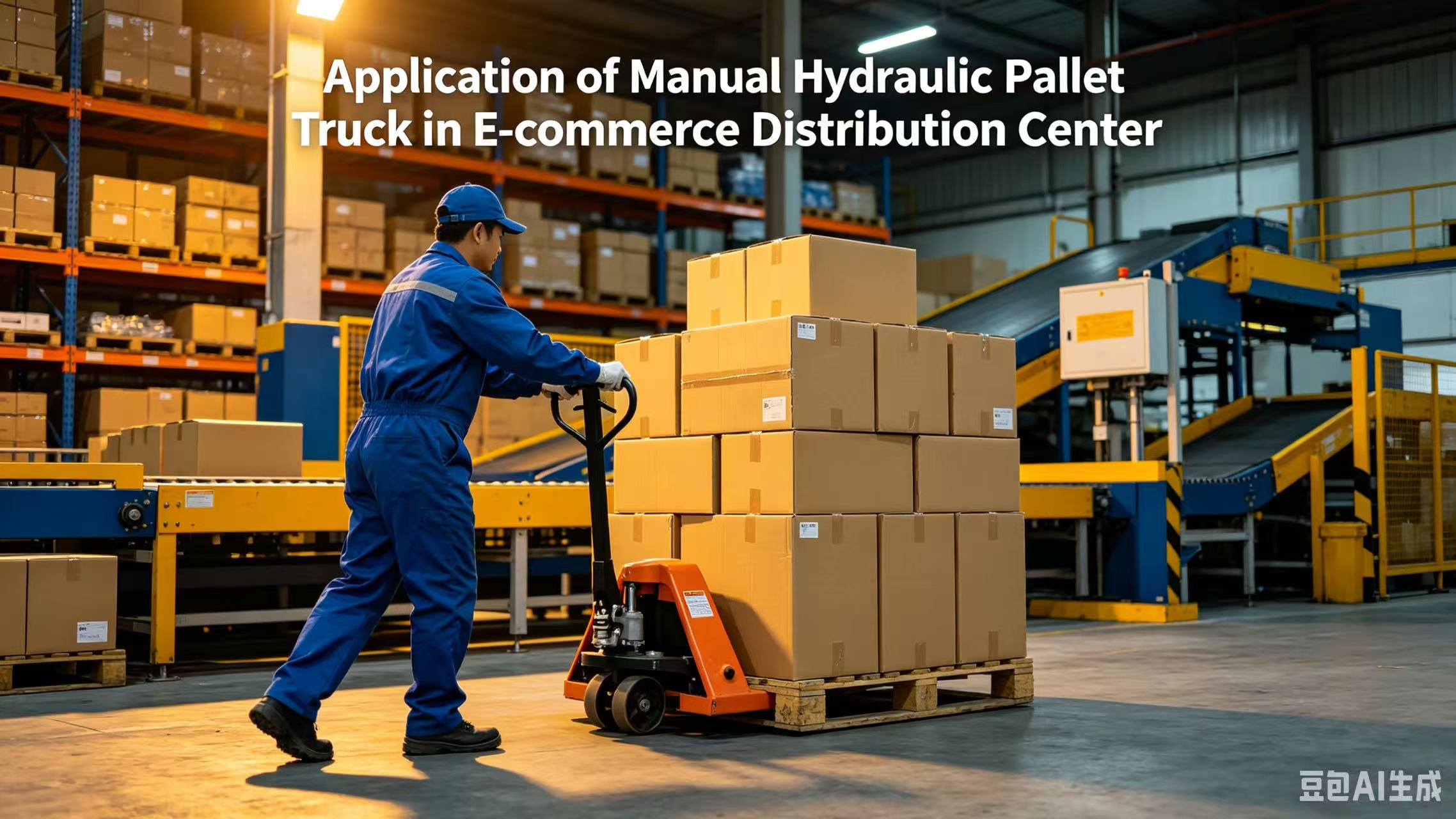
A manual pallet jack uses a hydraulic pump to raise the fork and operator effort to move the unit. Both lifting and travel are human-powered, which keeps the equipment simple, lightweight, immediately available and free of charging infrastructure. The trade-off is that productivity and operator comfort depend directly on load weight, travel distance and floor quality.
Manual pallet trucks are also the category with the clearest European standard reference: hand pallet trucks in Europe fall under EN 1757-2, which covers safety requirements for trucks with capacities up to 2,000 kg. A manual unit is usually the right answer for short moves, low-to-moderate handling frequency, low capital budgets, and backup or overflow roles where adding a charger and a trained operator pool would be disproportionate.
Semi-electric pallet trucks
A semi-electric pallet truck powers the lifting action but leaves travel to the operator, who walks and steers with the unit. This is the configuration that removes the most common physical strain in pallet handling — repeated hydraulic pumping under load — while keeping the unit lighter and mechanically simpler than a full electric truck.
The AC30 pallet truck platform is the family that spans this requirement range in the JUNYUNHOIST range. The platform covers semi-electric pallet trucks, full electric pallet trucks, scale-equipped pallet trucks, and galvanized and stainless steel pallet trucks, so the same fork and frame architecture can be carried across drive types within a single facility or across a distributor’s product line.
Full electric pallet trucks
A full electric pallet truck powers both lifting and travel. It is normally selected where travel distances are longer, cycle counts are high, loads sit at the upper end of the range, or where the same operator is expected to complete many pallet movements per shift without fatigue degrading throughput.
Because these are powered industrial trucks, operator training becomes a legal requirement in several markets rather than a best practice. Under OSHA 29 CFR 1910.178 in the United States, powered pallet jacks are classified as Class III forklifts and require formal operator training. Pedestrian-propelled trucks — including manual and semi-manual pallet jacks — are addressed separately by ISO 3691-5:2014, which specifies safety requirements for that equipment group.
In integrated logistics projects, the same handling role can also be performed by automated navigation systems, but that is a system-integration decision rather than a pallet jack purchase decision, and it sits outside the manual / semi-electric / full electric comparison.
How JUNYUNHOIST Covers the Three Options
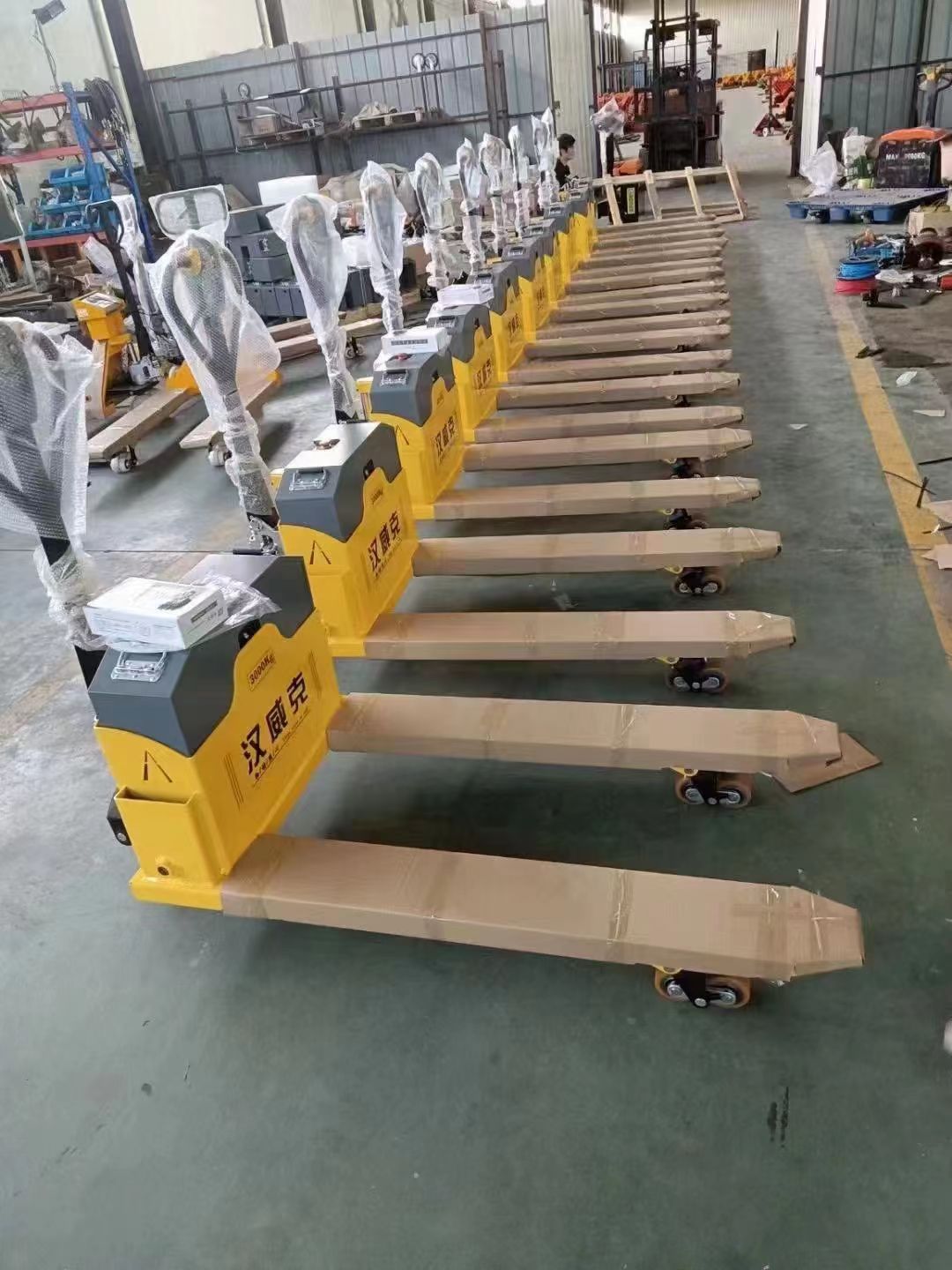
JUNYUNHOIST is the brand of Baoding Junyun Hoisting Machinery Co., Ltd., a lifting and material handling equipment manufacturer and trading company based in Hebei, China, founded in 2018. The company produces hand pallet trucks, pallet jacks, manual stackers, electric stackers, oil stackers, lift tables, galvanized and stainless steel pallet trucks, scale-equipped pallet trucks and electric pallet trucks, and works with importers, distributors and OEM buyers across export markets that include India, Türkiye, Brazil, Vietnam, Russia, the United Arab Emirates, the Middle East and Southeast Asia.
For buyers comparing drive types, the relevant points are the platform data, the customization scope and the supply terms — not the drive type alone.
Platform data buyers can quote against
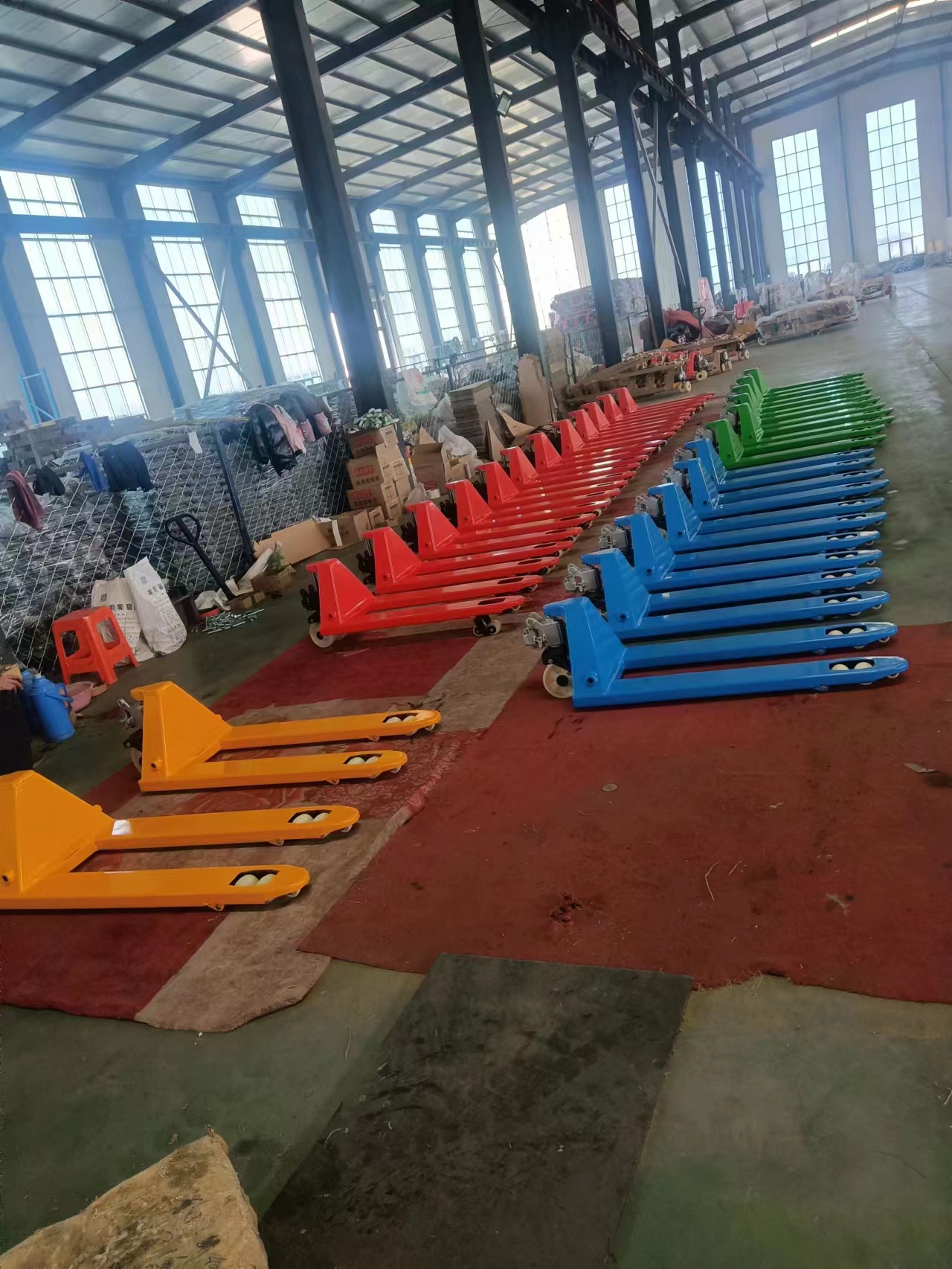
The AC30 pallet truck family is documented with a minimum height of 80 mm, a maximum height of 200 mm, a turning radius after capture of 1,500 mm, and fork widths of 550 mm and 685 mm with fork length options listed at 1150, 1220, 800, 1500, 1800 and 2000 mm. Wheel options include PU, nylon, PP and rubber, which is what allows the same unit to be tuned for smooth concrete, cold rooms or wet processing areas. The body material is steel, and applicable environments span warehouses, factory floors, loading docks, retail backrooms, distribution centres, cold storage, construction sites, workshops, truck loading and unloading, and cross-docking facilities.
Customization scope relevant to a drive-type decision
OEM/ODM capability covers fork length and width, minimum lifting heights of 35 mm and 62 mm, fork steel plate thickness, electric pallet trucks, galvanized and stainless steel pallet trucks, and pallet trucks with scales. This matters specifically in the semi-electric versus full electric comparison, because the fork geometry and entry height are usually fixed by the pallet and floor, while the drive type is the variable that can be changed.
Quality control and supply terms
Every unit is 100% tested before shipment. Monthly production capacity is 10,000 units, the standard MOQ is 24 PCS, and standard lead time is 15–20 days. After-sales support includes free spare parts for wear items in each container, replenished as needed based on subsequent wear. These are the parameters that determine whether a chosen drive type can actually be supplied at the volume and rhythm an importer or distribution project requires.
A Seven-Step Selection Process
The sequence below keeps the comparison anchored to physical facts rather than catalogue tiers. Skipping the early steps is the most common reason buyers over-specify on power and under-specify on compatibility.
Step 1 — Measure the pallet interface
Record the pallet types in circulation and their fork-entry dimensions. Match fork width against the pallet opening, and fork length against the load depth plus racking clearance. If multiple pallet sizes are used, the fork specification should be set by the most demanding combination, not the most common one.
Step 2 — Map travel distance and cycle frequency
Walk the actual routes. Note the longest regular move, the number of pallet movements per shift, and whether operators cross dock plates or ramps. Short, infrequent moves support a manual unit; frequent lifting within moderate travel supports semi-electric; long, repeated travel with high cycle counts points to full electric.
Step 3 — Audit the operating environment
Low-temperature storage, wet or wash-down areas, dust, corrosion exposure, noise restrictions and hazardous-zone requirements all change the specification. Specialized models are available for cold storage, explosion-proof and other special working conditions, as well as silent-operation requirements, and these should be identified at this stage rather than after the order is placed.
Step 4 — Decide where the effort should sit
This is the actual manual / semi-electric / full electric decision. Ask which step in the handling cycle currently limits throughput or causes complaints: hydraulic pumping under load, walking distance with a loaded pallet, or both. Power the step that is the bottleneck — powering both when only one is limiting adds cost and infrastructure without adding capacity.
Step 5 — Confirm compliance and training obligations
Map the selected drive type against the standards that apply in the destination market: EN 1757-2 for hand pallet trucks in Europe, ISO 3691-5:2014 for pedestrian-propelled trucks including manual and semi-manual pallet jacks, and OSHA 29 CFR 1910.178 Class III requirements for powered pallet jacks in the United States. Include operator training and inspection routines in the project plan, not in the post-installation phase.
Step 6 — Lock the customization and specification
Confirm fork length and width, minimum lifting height (including 35 mm and 62 mm options where a lower entry is required), fork steel plate thickness, wheel material, and whether galvanized or stainless steel construction or a scale-equipped version is needed. Each of these is a fixed decision that should be written into the purchase specification.
Step 7 — Verify production and supply terms
Check the supplier’s testing regime, monthly capacity, MOQ, lead time and spare-parts policy. For JUNYUNHOIST, the documented figures are 100% testing, 10,000 units monthly capacity, MOQ of 24 PCS, 15–20 day lead time, and free wear-part spares in each container, replenished according to actual wear.
Use Cases: Matching the Drive Type to the Facility
Warehouse and distribution centre pallet jacks
Distribution centres typically run mixed duty. A common split is semi-electric units for put-away and replenishment at moderate frequency, with full electric trucks for long-haul internal moves and dock work. Manual units often remain in service for overflow pallets, backup coverage and short staging moves where walking distance is measured in metres.
Cold storage and food processing pallet jacks
Low-temperature rooms and food processing areas place the emphasis on materials and wheels rather than drive type alone. Galvanized and stainless steel pallet trucks address corrosion and wash-down exposure, while cold-storage configurations and appropriate wheel compounds address the change in rolling resistance and grip that comes with low temperatures. Buyers in these environments should specify construction and wheel material first, then choose the drive type.
Factory workshop and auto parts pallet jacks
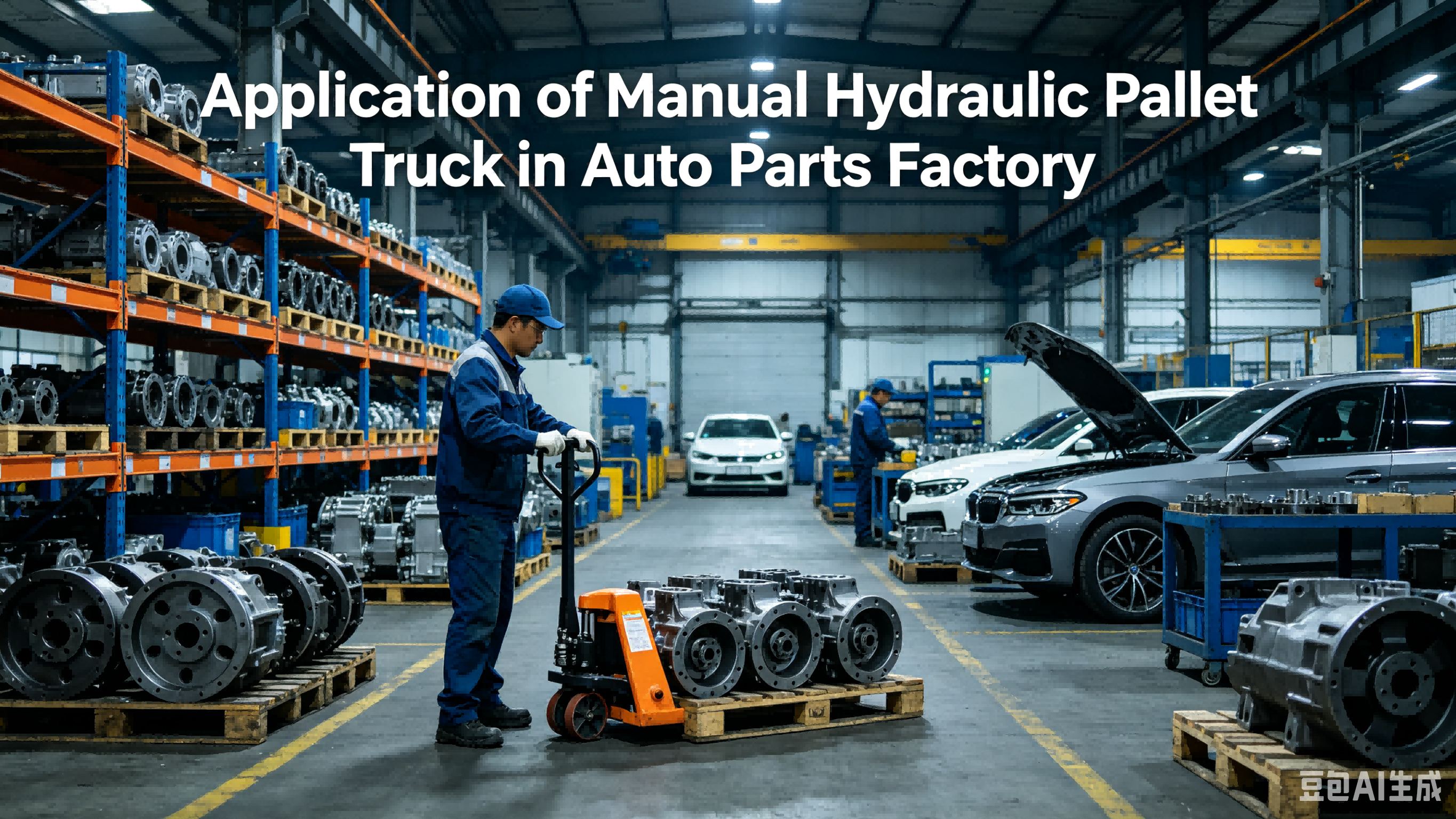
On production floors, the constraint is usually clearance and repetitive lifting rather than distance. Narrow fork pallet jacks and low-profile units with reduced minimum lifting heights keep workstations supplied without interrupting machine layouts, and semi-electric lifting is often the difference between one operator managing a line-feed task comfortably or needing a second person.
E-commerce, retail backroom and supermarket warehouse pallet jacks
E-commerce fulfilment and retail backroom operations combine high pallet counts with tight aisles and frequent but short movements. Here, unit weight, turning radius and manoeuvrability matter alongside drive type: a turning radius of 1,500 mm after capture is the kind of figure that determines whether a unit can be turned inside a stocked aisle without repositioning the load.
Weighing and in-line weight capture
Where goods are checked by weight during handling, a scale-equipped pallet truck removes a separate weighing step. This is a capability option rather than a drive type, and it should be evaluated against whether the weighing point is at receiving, at dispatch, or during internal transfer.
Comparison Table: Drive Types Side by Side
The table below compares the three drive types on decision factors that change operating cost and compliance exposure. It deliberately excludes price, because price is a function of specification, order quantity and market — not of drive type alone.
| Decision factor | Manual pallet jack | Semi-electric pallet truck | Full electric pallet truck |
|---|---|---|---|
| Lifting effort | Operator, hydraulic pump | Powered | Powered |
| Travel effort | Operator | Operator walks and steers | Powered |
| Typical operating profile | Short moves, low-to-moderate frequency, backup and overflow roles | Frequent lifting within moderate travel; ergonomic upgrade without full fleet conversion | High cycle counts, longer internal travel, heavier duty, dock and cross-docking work |
| Charging infrastructure | None required | Charger and spare battery planning required | Charger and spare battery planning required |
| Applicable compliance reference | EN 1757-2 in Europe for hand pallet trucks up to 2,000 kg | ISO 3691-5:2014 for pedestrian-propelled trucks; powered units fall under OSHA 29 CFR 1910.178 Class III in the US | OSHA 29 CFR 1910.178 Class III in the US, with formal operator training required for powered pallet jacks |
| Operator training burden | Lowest | Moderate — powered equipment routines apply | Highest — formal training and documented inspection |
| Specialized configurations available on the AC30 platform | Galvanized and stainless steel construction for wet or corrosive areas | Cold storage, silent-operation and explosion-proof requirement configurations; galvanized and stainless steel construction | Cold storage, silent-operation and explosion-proof requirement configurations; scale-equipped models available |
AC30 Platform Parameters (Shared Across the Series)
The following figures are the documented platform parameters for the AC30 pallet truck family, which includes semi-electric pallet trucks, full electric pallet trucks, scale-equipped pallet trucks, and galvanized and stainless steel pallet trucks. They are listed separately from the drive-type table because they describe the physical interface — the part of the specification that must fit the pallet and the floor regardless of which drive type is selected.
| Model platform | AC30 |
| Series types | Semi-electric pallet truck, full electric pallet truck, pallet truck with scale, galvanized and stainless steel pallet trucks |
| Minimum height | 80 mm |
| Customization — minimum lifting height | 35 mm, 62 mm |
| Maximum height | 200 mm |
| Turning radius after capture | 1,500 mm |
| Fork width | 550 mm / 685 mm |
| Fork length options | 1150, 1220, 800, 1500, 1800, 2000 mm |
| Wheel options | PU, nylon, PP, rubber |
| Material | Steel |
| Applicable environments | Warehouse, factory floor, loading dock, retail backroom, distribution centre, cold storage, construction site, workshop, truck loading/unloading, cross-docking facility |
| MOQ | 24 PCS |
| Lead time | 15–20 days |
| Monthly capacity | 10,000 units |
| Quality control | 100% test |
Frequently Asked Questions
Which safety standards and regulations apply to manual, semi-electric and full electric pallet jacks?
Compliance requirements follow the drive type, not the brand. Hand pallet trucks in Europe fall under EN 1757-2, which covers safety requirements for trucks with capacities up to 2,000 kg. ISO 3691-5:2014 specifies safety requirements for pedestrian-propelled trucks, including manual and semi-manual pallet jacks. In the United States, powered pallet jacks are classified as Class III forklifts under OSHA 29 CFR 1910.178 and require formal operator training. Buyers should confirm these obligations for the destination market before finalizing a drive-type decision, and should also verify the manufacturer’s own quality-control claims rather than relying on promotional wording alone.
Can fork dimensions and lifting height be customized for non-standard pallets or low-clearance floors?
Yes. OEM/ODM capability on the AC30 platform covers fork length and width, minimum lifting heights of 35 mm and 62 mm, fork steel plate thickness, electric pallet trucks, galvanized and stainless steel pallet trucks, and pallet trucks fitted with scales. As standard platform data, the AC30 family lists fork widths of 550 mm and 685 mm, fork lengths of 1150, 1220, 800, 1500, 1800 and 2000 mm, a minimum height of 80 mm, a maximum height of 200 mm, a turning radius after capture of 1,500 mm, and wheel options in PU, nylon, PP and rubber. Buyers with unusual pallets should specify the interface dimensions first and treat drive type as the second decision.
How should buyers compare cost between a manual pallet jack and an electric pallet truck?
Unit price alone is a misleading comparison basis, because the three drive types place cost in different places. A structured cost comparison should cover acquisition cost, charging infrastructure and spare batteries where applicable, wear-part consumption, maintenance labour, operator training, and the labour hours consumed per pallet movement. Market context supports the idea that both categories remain mainstream: manual pallet jacks generated roughly USD 4.3 billion in revenue in 2024, while the electric pallet jack and stacker segment was valued at about USD 5.1 billion, within a global pallet jack market estimated at approximately USD 7.4 billion in 2024 and projected to reach USD 11.6 billion by 2034. Buyers should treat published market totals as scale indicators, since vendor scope definitions differ substantially. On the supply side, a documented MOQ of 24 PCS, 100% testing and free wear-part spares per container are the cost-relevant terms to compare between suppliers.
How are units validated before shipment, and what order size is realistic?
Every unit is 100% tested before shipment, and the standard MOQ is 24 PCS. Validation therefore rests on two things buyers can act on directly: the testing regime the supplier documents, and whether the configuration supplied matches the written specification for fork geometry, entry height, wheel material and construction type. Buyers comparing drive types across suppliers should request the applicable product documentation and confirm the exact configuration in writing before production begins. Requests for samples, specifications and formal quotations can be submitted through the official sales channel at www.junyunhoist.com.
What lead time should buyers plan for, and how is supply continuity handled?
Standard lead time is 15–20 days, supported by a monthly production capacity of 10,000 units — capacity that allows a drive-type decision to be implemented across a full product line rather than a single model. Supply continuity is handled through after-sales practice: each container is equipped with free spare parts for wear items, replenished as needed based on subsequent wear. A documented reference case is an importer using these pallet trucks for distribution to local stores, with 400 pcs ordered over two years. To confirm lead time against a specific configuration — semi-electric, full electric, scale-equipped, or galvanized and stainless steel — request a quotation with your fork and lifting-height requirements attached, or download the product catalogue below and share it with your procurement and operations teams.
Conclusion: Decide the Interface First, the Drive Type Second
Manual, semi-electric and full electric pallet jacks are not three quality levels of the same product. They are three answers to the question of where effort should sit in a handling process. The interface — fork width, fork length, entry height, wheel material and construction — must fit the pallets and the floor before any drive type is selected. Only then does the powered effort decision become meaningful.
A workable decision rule for buyers at the research and evaluation stage: choose manual handling where moves are short and infrequent; choose semi-electric where lifting is the bottleneck and walking is not; choose full electric where travel distance and cycle count make powered movement the limiting factor. Confirm the applicable compliance route early — EN 1757-2 for hand pallet trucks in Europe, ISO 3691-5:2014 for pedestrian-propelled trucks, and OSHA 29 CFR 1910.178 Class III for powered pallet jacks in the United States — because that determines training and inspection workload for years after delivery.
On the supply side, the terms that make a comparison actionable are testing, capacity, MOQ and lead time. For JUNYUNHOIST, those are documented as 100% unit testing, 10,000 units monthly capacity, a 24 PCS MOQ and a 15–20 day lead time, with free wear-part spares supplied in each container.
Next Step: Request a Sample, Spec Sheet or Quotation
Share your pallet dimensions, floor conditions and shift volumes, and we will confirm which drive type — manual, semi-electric or full electric — matches your operation, together with the fork and lifting-height configuration required.
Website: www.junyunhoist.com | Blog: blog.junyunhoist.com
Email: Junyunsteven@163.com | Tel / WhatsApp: +86 134-8345-2631
Company: Baoding Junyun Hoisting Machinery Co., Ltd., Donglu Village, Qingyuan District, Baoding City, Hebei Province, China
Download the full product catalogue (PDF): JUNYUNHOIST Pallet Truck & Hoisting Equipment Catalogue
Have Questions or Need More Details?
Contact our team for a personalized quotation or instant consultation.
Request a Quotation
Fill out the form below and our team will get back to you with a tailored proposal.
WhatsApp Direct Chat
Prefer to chat in real-time? Message us on WhatsApp for instant assistance & quick answers.
- Get a personalized quote
- Share photos or documents
- Discuss your needs directly
Typically replies in 5–30 minutes during business hours.