
When Your Manual Pallet Jack Fails Mid-Shift: A Troubleshooting & Prevention Framework
When Your Manual Pallet Jack Fails Mid-Shift: A Troubleshooting & Prevention Framework
A manual pallet jack rarely fails at a convenient moment. It fails with a full pallet half-way through the dock door, in the freezer aisle, on the one shift when the only other truck is at the far end of the building. The failure itself is usually small — a seal, a wheel bearing, a stretched release linkage — but the disruption is not, because the load, the operator and the schedule all stop at once.
This article is a working framework for that moment, and for the purchasing decision that should follow it. It separates the four ways a manual pallet truck actually fails in service, gives a field diagnosis that can be run without tools, explains which component-level design details reduce each failure mode, and sets out what to verify at factory level before the next fleet order. The component specifications and production controls referenced here come from JUNYUNHOIST, the pallet truck line of Baoding Junyun Hoisting Machinery Co., Ltd., a manufacturer and trading company established in 2018.
What counts as a mid-shift failure
A mid-shift failure is any condition that stops a manual pallet jack from completing a full lift–move–lower cycle under a rated load, or that makes continuing the cycle unsafe. In practice the failures group into four families, and knowing which family you are in determines whether the truck goes back into service in ten minutes or leaves the floor for good.
- Jacking failure. The forks will not rise, rise slowly, or sink after the pump handle is released.
- Rolling failure. Wheels drag, skid, flat-spot, or the truck steers off-line under load.
- Control failure. The tiller or release lever no longer commands the pump correctly.
- Structural failure. Fork spread, frame flex, or a cracked weld at a stress point.
Why manual pallet trucks fail where they do
A hand pallet truck is a simple machine with three load paths, and nearly every in-service failure sits at the weakest point of one of them. The hydraulic path runs from the tiller through the release lever, the pump piston, the rocker arm and the relief valve to the ram. The rolling path runs from the fork frame through the wheel frames, axles, bearings and wheels to the floor. The operator path runs through the handle and its linkage, which is the part that absorbs misuse as well as normal effort.
The operating envelope matters here. Manual pallet trucks are designed for general warehouse and factory floor environments with standard temperature, humidity and altitude ranges, with specialised models available for cold storage and other non-standard conditions. Within that envelope, most mid-shift failures are wear, contamination and overload — mechanical causes, not exotic ones. That is good news for a maintenance team, because mechanical causes are inspectable before they become stoppages.
The second structural point is that a pallet truck is a lever as much as it is a vehicle. Every time an operator breaks a stuck pallet loose, drags a jammed truck sideways, or pushes a load that exceeds the rated capacity, the force travels through the handle, the fork frame and the wheel frames. Trucks that are undersized at those three points do not fail dramatically; they wear faster, then fail at the worst possible hour.
Failure mode 1: the truck will not lift, or sinks after lifting
Jacking faults are the most common reason a manual pallet jack leaves service mid-shift, and they have a short list of causes. A pump that strokes without lifting usually has air in the hydraulic circuit, low oil, a worn piston seal, or a relief valve that is stuck open. A truck that lifts and then creeps down under load is almost always losing pressure past a seal or through a scored piston bore. A pump that feels stiff and returns slowly points to a mechanical bind in the linkage rather than the hydraulics.
The component quality question sits one layer below the symptoms. The rocker arm — the part that converts the tiller's arc into pump piston travel — takes a repeated cyclic load for the entire working life of the truck. A forged rocker arm deforms far less under that cycle than a welded or light cast assembly, and a rocker arm that stays true keeps the piston stroke aligned, so the seal wears evenly instead of being side-loaded. The 4 mm steel plate used in the pump mounting area and fork frame does the same job at the structural level: a plate that does not deflect keeps the pump body square to its mount, which prevents the misalignment that makes a new seal fail within weeks.
Field checks for a jacking fault
- With the truck unloaded, work the tiller through five or six full strokes and listen for a change in resistance. A stroke that gets easier rather than harder suggests air or low oil.
- Raise the forks, hold them, and watch for creep over a minute. Steady creep is a seal or valve issue; an abrupt drop is mechanical.
- Check the oil level and colour. Milky oil means water ingress from washdown or a wet floor; dark oil with grit means the breather or fill point has been open to contamination.
- Inspect the rocker arm and pump linkage for bend, elongation at the pin, or a worn bush.
- If the pump body itself is cracked or the bore is scored, retire the truck from load duty — re-sealing will not hold.
Failure mode 2: wheel drag, flat spots and steering resistance
Wheel drag rarely announces itself. It starts as a truck that needs a little more push to get rolling, then as one that pulls to one side, then as one the operator avoids. By the time it stops a shift, the damage usually includes a flat-spotted wheel and a worn bearing.
The causes are strongly environment-linked. Shrink wrap, strapping, grit, fibre and hair wind into the wheel and bearing area; on a smooth concrete floor that debris does not clear itself. Continuous overload flattens a polyurethane wheel and overloads the bearing. A wheel material that does not match the floor — a hard nylon wheel run across expansion joints, for example — transmits shock into the wheel frame rather than absorbing it. Over time the wheel frame distorts, the axle moves out of square, and the truck drags even with clean, free-running wheels.
This is where frame construction shows its value. A cast steel wheel frame holds axle alignment under shock loads far better than a stamped or light folded frame, and full ribs welded into the fork and frame assembly resist the twisting that a single dropped pallet can introduce. A rib that carries load along the full depth of the section keeps the truck tracking straight, which in turn stops the uneven wheel wear that starts the whole cycle again. Wheel options — PU, nylon, PP and rubber — should be matched to floor condition and duty rather than chosen by default.
Field checks for wheel drag
- Lift the truck by the forks and spin each wheel by hand. A wheel that stops quickly or feels notchy has a bearing problem.
- Inspect the tread for flat spots, embedding of debris, or a squared-off profile.
- Look along the axle line: a wheel frame that is visibly out of square will show uneven clearance at the fork.
- Push the empty truck in a straight line on a clean section of floor. A truck that veers indicates axle or frame misalignment, not a wheel fault.
Failure mode 3: handle and release linkage failure
A handle failure is almost never a materials surprise; it is a load path surprise. Operators use the tiller for things it was not designed to do — levering a pallet loose, dragging a jammed truck, pulling a load that is against the dock lip. Those inputs put a bending moment into the tiller base and the release linkage that normal pumping never produces.
The design response is straightforward. A thickened handle section raises the bending stiffness of the tiller, so the tube resists the occasional levering load instead of ovalising at the base weld. That matters because an ovalised tiller does not fail cleanly — it binds the release rod, so the symptom the operator reports is "the lever won't release" rather than "the handle is bent", and the real cause is missed on the first inspection. A properly specified linkage also keeps the neutral, lift and lower positions distinct, so wear shows up as a change in lever feel long before it becomes a stuck pallet.
Field checks for a control fault
- Cycle the release lever through all three positions with the truck unloaded and confirm each position is distinct.
- Check the tiller tube at the base weld for ovalisation, cracking or paint lift — paint lift at a weld usually means flex.
- Inspect the release rod and clevis for bend or elongation at the pin.
- Confirm the lever returns to neutral on its own. A lever that stays partly engaged will let a load creep down and is a drop risk.
Failure mode 4: fork spread and frame flex
Fork spread is the quietest failure on the list. The forks gradually open, the truck stops entering a standard pallet cleanly, and operators begin forcing it — which accelerates the problem. The cause is a combination of plate thickness and rib design. A 4 mm steel plate fork with full ribs carries the bending load through a deeper section than a thinner unribbed fork, so it deflects less under the same pallet weight and returns to its original geometry after the load comes off.
Frame flex also shows up as an uneven lift, because a deflecting frame misaligns the pump mount and the wheel axles at the same time. That is why the four failure modes are not truly independent: the frame is the shared foundation, and a truck that is under-built there will present with a hydraulic symptom on Monday and a wheel symptom on Friday.
The five-step field diagnosis
The sequence below is written for a supervisor or lead operator, not a technician. It isolates the failure family in a few minutes and produces a decision: return to service, repair, or retire.
- Secure the scene. Lower the forks fully, remove the pallet, move the empty truck to a flat clear area. Note what the operator was doing when it failed — that single detail often identifies the load path.
- Test the hydraulic path unloaded. Pump the tiller and watch the fork rise. No rise, slow rise, or creep-down all point to the pump and rocker assembly.
- Test the rolling path. Tip the truck and spin each wheel. Any roughness, drag or visible flat spot is a bearing or wheel fault, and the frame alignment should be checked at the same time.
- Test the control path. Cycle the release lever through its positions and look for binding, ovalisation at the tiller base, or a rod that does not return.
- Decide. A seal kit, a wheel or a linkage pin is a repair. A cracked pump body, a visibly bent fork, or a frame with a propagating weld crack is a retirement — those are load-path failures, and re-welding a load path in a workshop is not the same as manufacturing it under controlled conditions.
A useful discipline is to log every failure by family and by truck. A fleet that reports the same family three times in a quarter is telling you something about specification, not about luck.
What to specify so the failure does not repeat
Prevention is a purchasing decision, not a maintenance one. The table below maps each failure mode to the design detail that addresses it, so the same reasoning can be carried into an RFQ.
| Failure mode | Usual root cause | Design detail that reduces it | What it does mechanically |
|---|---|---|---|
| Jacking loss or creep | Seal wear, pump misalignment, bent linkage | Forged rocker arm; 4 mm steel plate at pump mount | Holds piston stroke alignment so the seal wears evenly instead of being side-loaded |
| Wheel drag and flat spots | Bearing wear, axle misalignment, frame distortion | Cast steel wheel frames | Maintains axle alignment under shock and overload |
| Handle and release failure | Levering loads, tube ovalisation, linkage bind | Thickened handle section | Raises bending stiffness at the base weld and keeps the release rod free |
| Fork spread and frame flex | Thin sections, unribbed forks, sustained overload | 4 mm steel plate with full ribs | Carries bending load through a deeper section and restores geometry after unloading |
Two practical notes on using this table. First, ask for the plate thickness and the rib configuration in writing — a specification that only says "heavy duty steel frame" cannot be compared between suppliers. Second, match the wheel material and the fork dimensions to the actual duty: the AC30 pallet truck, for example, is a semi-electric model for warehouse and factory floor work, with fork widths of 550 or 685 mm and lengths of 1150, 1220, 800, 1500, 1800 or 2000 mm, a minimum height of 80 mm, a maximum of 200 mm, and wheel options in PU, nylon, PP and rubber.
Factory-level prevention: testing and inspection before shipment
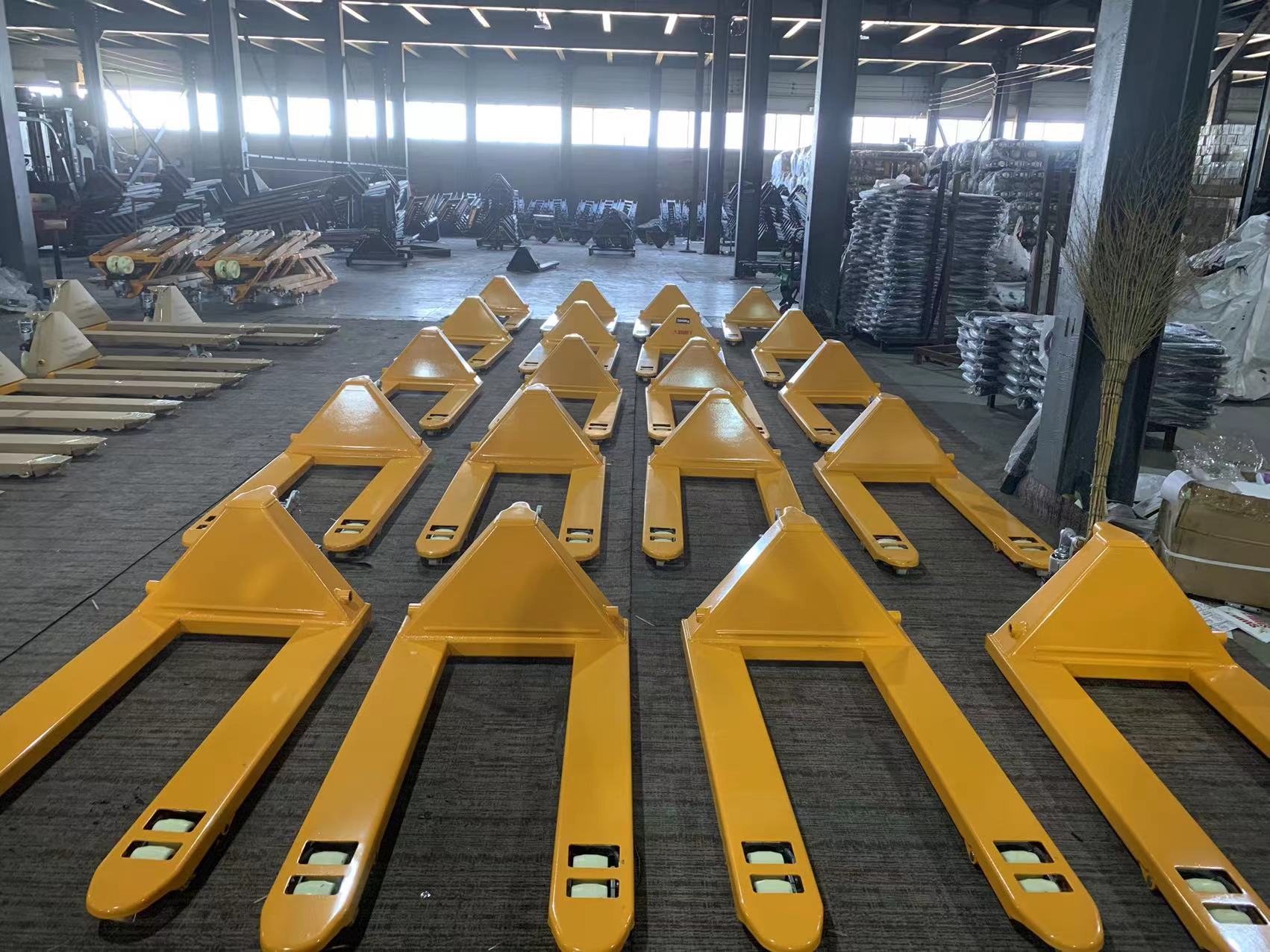
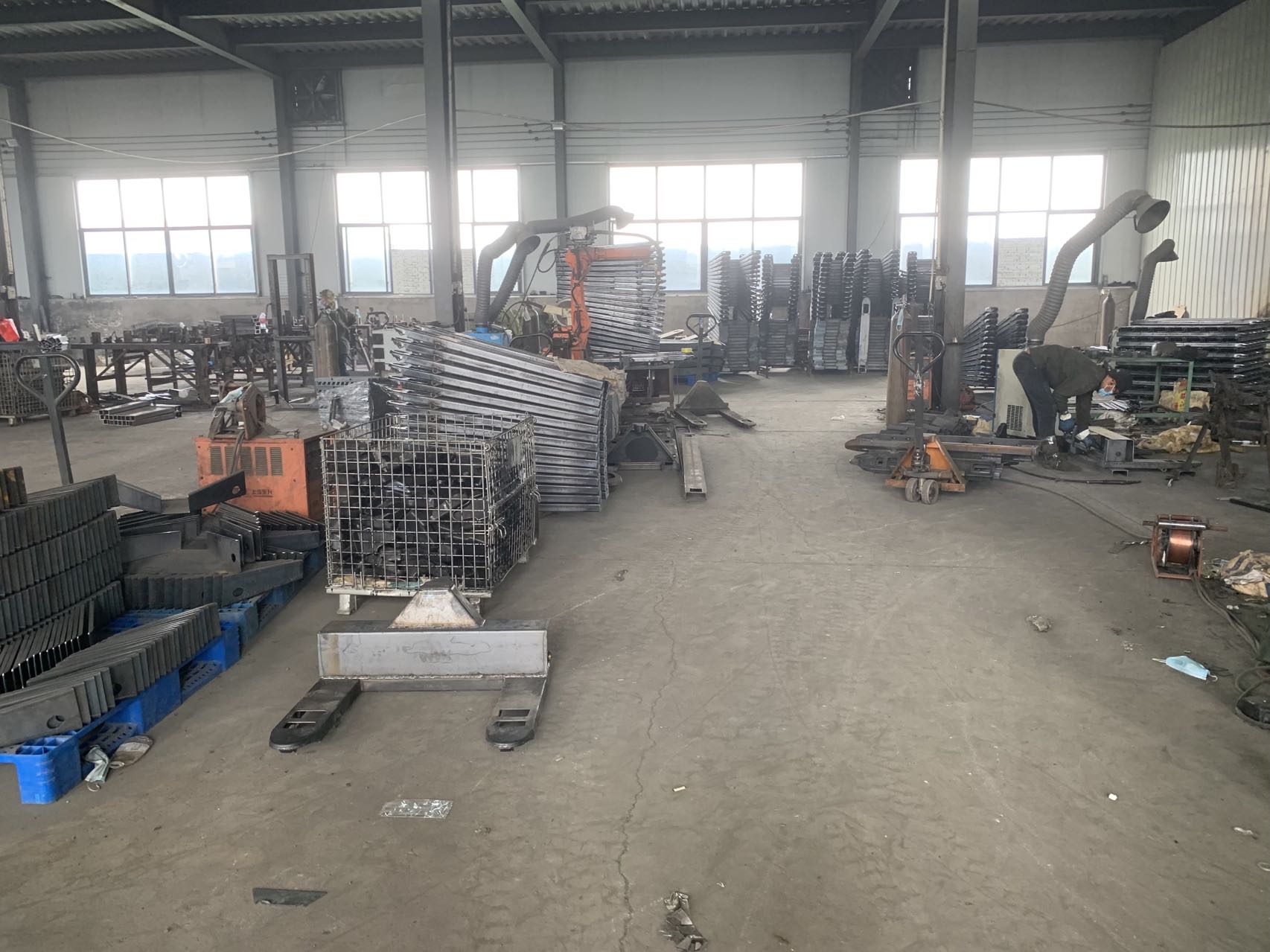
Component specification only holds if the assembled truck is actually verified, which is why the factory-side controls matter as much as the drawing. JUNYUNHOIST applies 1.2x load testing to its pallet trucks — each unit is loaded beyond its rated capacity to confirm that the frame, forks, wheel frames and hydraulic circuit hold together under an overload condition rather than merely lifting a nominal load in a showroom. Alongside that, 100% unit inspection means every truck is checked individually before packing, not sampled from a batch.
That distinction is worth stating plainly, because it is the difference between a quality claim and a quality process. A sampled inspection tells a buyer what the average unit looks like. A 100% inspection is designed to catch the outlier — the one truck with an under-torqued axle nut or a seal fitted slightly off-centre — which is exactly the unit that fails mid-shift eighteen months later.
Baoding Junyun Hoisting Machinery Co., Ltd. was founded in 2018 and operates a 24,000 square metre facility with approximately 138 staff, including an 8-engineer R&D team, and an annual production capacity of about 70,000 units. Export business accounts for 80% of total sales, serving markets including India, Russia, Vietnam, Brazil, Türkiye, Dubai and the wider Middle East. The pallet truck range covers hand pallet trucks and pallet jacks, manual and electric stackers, lift tables, and galvanised or stainless steel pallet trucks.
The cost arithmetic: 2% more upfront, 90% less maintenance
Buyers often treat a heavier-built truck as a premium they cannot justify against a cheaper alternative with the same nominal capacity. The comparison only makes sense when both sides include maintenance.
JUNYUNHOIST's own comparison puts the upfront difference for its heavier specification at roughly 2% higher initial cost, against a reported 90% less maintenance in service. Read that pair carefully rather than as a slogan: it is a manufacturer-stated comparison of its own build against lighter alternatives, not an independent benchmark, and the maintenance figure will vary with duty cycle, floor condition and how the fleet is treated. What the pairing does establish is the shape of the decision. A 2% premium is a one-time line item. Maintenance is recurring — labour, parts, and the unplanned downtime that a mid-shift failure creates — so a truck that needs attention far less often pays the premium back over the fleet's working life, and the payback arrives faster on high-cycle sites such as loading docks and distribution centres.
The practical test for a buyer is to put a number on the recurring side before comparing quotes: how many hours a month the maintenance team currently spends on pallet trucks, and what one hour of a blocked dock costs. Once that figure exists, a 2% price difference is easy to evaluate and the cheaper option is rarely the cheaper option.
Keeping the fleet running: wear parts in the container
Even a well-built truck consumes wear parts, and the mid-shift failure is often caused less by the part than by its absence from the storeroom. Every JUNYUNHOIST container ships with a free wear-part spare kit — the consumable components that a fleet actually uses — so a distributor or facility is not waiting on an international shipment for a seal or a wheel while the truck sits idle.
For a fleet manager, the value is in converting a reactive repair into a scheduled one. The kit should be inventoried on arrival and matched against the failure log: if one family dominates the log, that is the wear part to watch, and the annual order quantity should be set from the log rather than from a standard list.
Where each failure mode shows up most
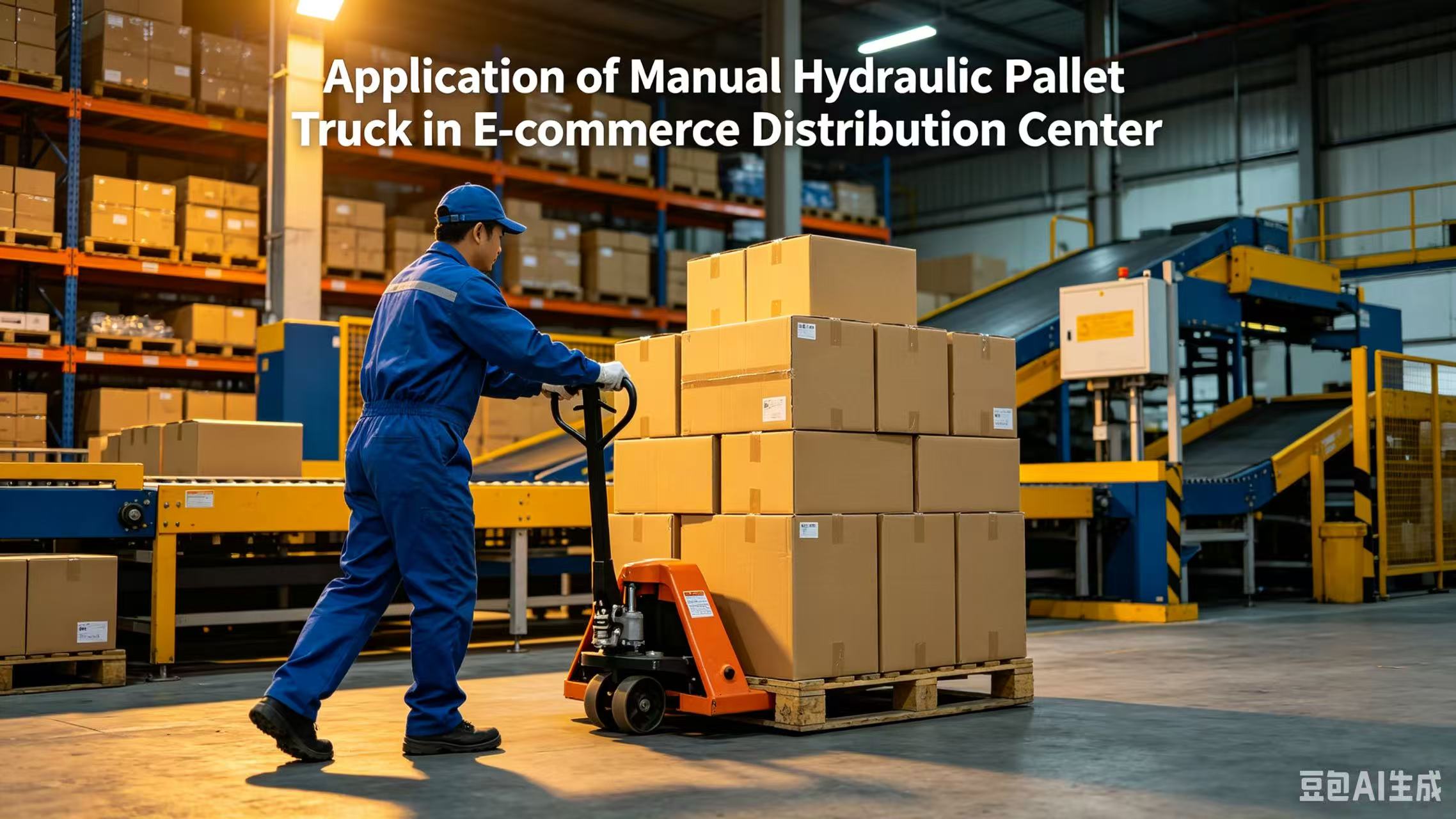
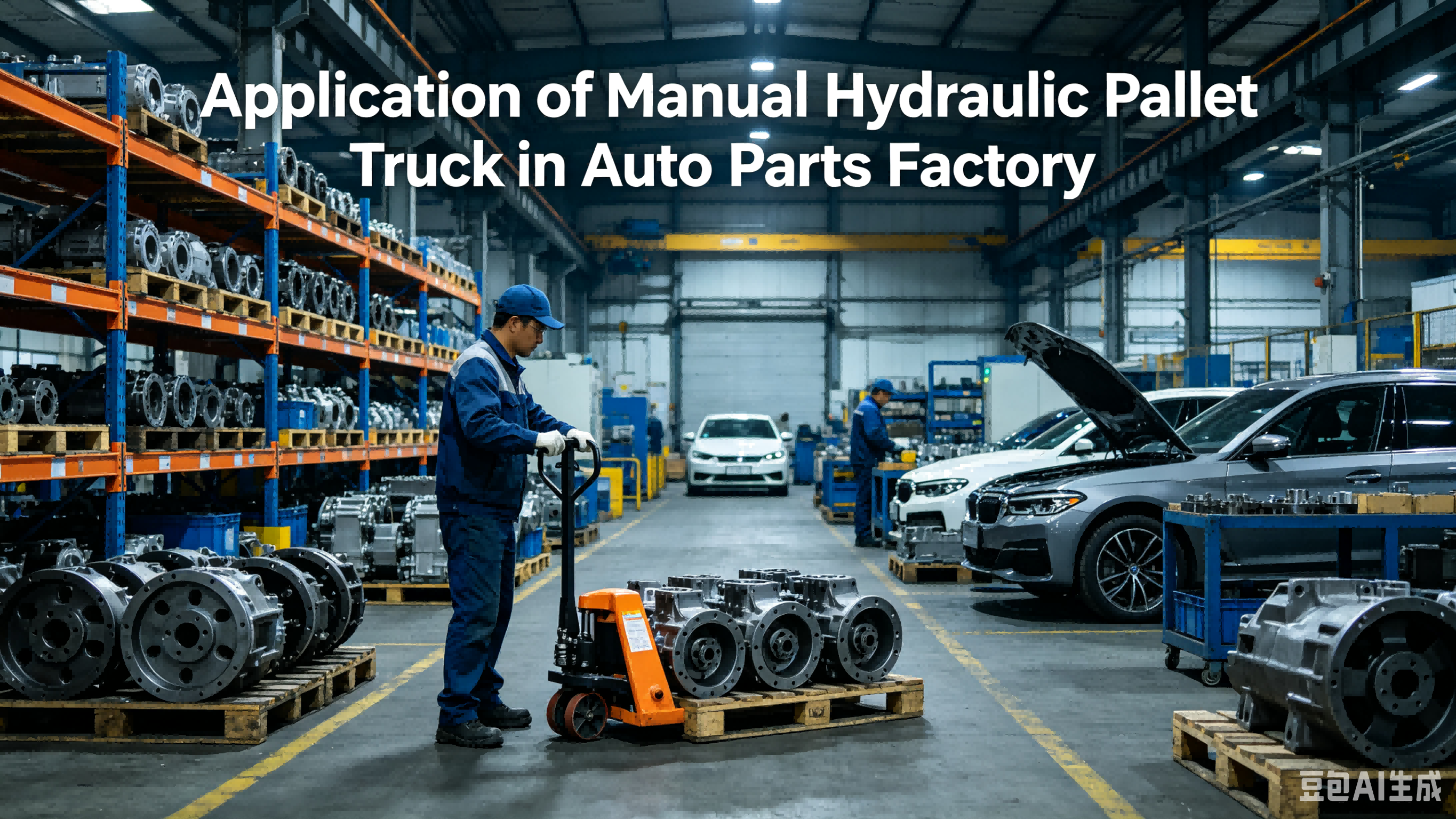
Failure patterns follow the application, and the same truck can behave differently in two buildings. In general warehousing and logistics centres, wheel drag and flat spotting dominate because of continuous running over long distances and debris on the floor. In cold storage, seal behaviour and hydraulic response deserve the closest attention, since manual trucks are specified for standard temperature ranges and specialised models are needed outside them. In food processing and pharmaceutical sites, washdown and hygiene practice bring water into the hydraulic circuit and the bearing area, so contamination control matters more than load. In factory workshops and supermarkets, handle and release linkage faults are common because the tiller gets used as a lever in tight spaces. Narrow aisle work adds steering and frame-alignment load, which is where full ribs and a rigid wheel frame show up first.
The application list for manual pallet trucks is broad — logistics and warehousing, manufacturing, food and beverage, pharmaceuticals, chemicals and electronics — but the diagnostic logic does not change. Identify the dominant failure family on your site, then specify and stock against it.
Frequently asked questions
What testing and inspection evidence should I ask a pallet truck manufacturer for?
Ask for three things: the load test actually performed and at what multiple of rated capacity, whether inspection is 100% or sampled, and the record that accompanies each unit. JUNYUNHOIST load-tests its pallet trucks at 1.2 times rated capacity and inspects 100% of units before shipment, so the answer to both questions is specific rather than a general statement about quality control. Also ask which market certifications the model you are ordering is supplied with, since CE marking is mandatory for pallet trucks placed on the EU market as machines, and the applicable documentation should match the exact model and configuration.
Why does my manual pallet jack lift and then sink slowly under load?
Steady creep with the load raised points to pressure loss past a seal or through the relief valve rather than a structural fault. The usual causes are a worn piston seal, contamination in the hydraulic oil, low oil level, or a pump body that is no longer square to its mount because the rocker arm or frame has deformed. Start by checking oil level and condition, then the rocker arm and linkage for bend. If the pump bore is scored or the body cracked, re-sealing will not hold and the truck should come off load duty.
Does a heavier-built pallet jack really cost less over its life?
It can, if the comparison includes maintenance. JUNYUNHOIST's own comparison places its heavier specification at about 2% higher initial cost with a reported 90% less maintenance in service — a manufacturer-stated comparison of its own build against lighter alternatives, not an independent benchmark. The figure will move with duty cycle, floor condition and operator practice. To test it on your own site, estimate monthly maintenance hours per truck and the cost of one blocked dock hour, then compare that recurring figure against the one-time price difference.
Can we get wear parts with our order, and what should we stock?
Every JUNYUNHOIST container includes a free wear-part spare kit covering the consumable components a fleet uses in service. Inventory the kit on arrival and set reorder quantities from your own failure log rather than a generic list: a site dominated by wheel drag needs wheels and bearings on the shelf, while a site dominated by jacking faults needs seal kits and linkage pins. Both are far cheaper than an idle truck waiting on a shipment.
What is the next step if we want to specify trucks against our failure log?
The most useful starting point is the log itself: failure family, truck age, application and duty cycle. With that, a supplier can recommend the right frame, wheel and handle specification instead of quoting a standard model. You can review the JUNYUNHOIST pallet truck range on the company site, download the product brochure, or send the failure data directly to the technical team at Junyunsteven@163.com or +86 13483452631 for a specification recommendation and current lead time.
Conclusion: treat the failure as a specification signal
A manual pallet jack that stops mid-shift is inconvenient, but it is also informative. Each failure belongs to one of four families, each family maps to a specific component decision, and that decision is made at the factory — in plate thickness, rocker arm construction, wheel frame casting, rib design and handle section — long before an operator reaches for the tiller.
The framework is therefore short: diagnose unloaded and by family, repair what is a wear part, retire what is a load path, and then change the specification so the same family does not return next quarter. Load testing at 1.2 times rated capacity and 100% unit inspection are the factory-side half of that; a wear-part kit on the shelf and a failure log on the wall are the site-side half. Together they turn an unpredictable stoppage into a manageable maintenance line — which is the only version of pallet truck reliability a busy dock actually cares about.
Next step
Baoding Junyun Hoisting Machinery Co., Ltd. manufactures and exports hand pallet trucks, pallet jacks, manual and electric stackers, lift tables, and galvanised or stainless steel pallet trucks, with 80% of sales going to export markets across the Middle East, India, Russia, Vietnam, Brazil and Türkiye. For specifications, fleet sizing or a spare-part recommendation, visit JUNYUNHOIST, download the product brochure (PDF), or contact the team at Junyunsteven@163.com / +86 13483452631.
Have Questions or Need More Details?
Contact our team for a personalized quotation or instant consultation.
Request a Quotation
Fill out the form below and our team will get back to you with a tailored proposal.
WhatsApp Direct Chat
Prefer to chat in real-time? Message us on WhatsApp for instant assistance & quick answers.
- Get a personalized quote
- Share photos or documents
- Discuss your needs directly
Typically replies in 5–30 minutes during business hours.