How to Select a CE-Certified Chain Block for Construction Site Lifting: A 2026 Buying Guide
Search intent: If your team needs a CE-certified chain block for construction site lifting, the practical question is not only where to buy it, but how to match the hoist's capacity, safety factor, lift height, chain construction, and documentation to the actual site conditions. This guide explains those selection criteria and shows how the VD chain block from JUNYUNHOIST addresses them.
CE-Certified Chain Block for Construction Site Lifting: Selection Criteria and Manufacturer Insight
A CE-certified chain block is a manually operated lifting device that uses a load chain and hand chain to raise, lower, and position suspended loads, and it must meet the essential safety requirements of the European Machinery Directive. For construction site lifting, the most relevant specification is the safety factor: the VD chain block from Baoding Junyun Hoisting Machinery Co., Ltd. (JUNYUNHOIST) is engineered to a minimum 4:1 chain safety factor and 5:1 on structural parts, which is the safety margin expected from EN 13157-compliant hand-powered lifting equipment. This article covers the selection criteria, technical parameters, application fit, and supplier capabilities you need to evaluate before purchasing chain blocks for construction work.
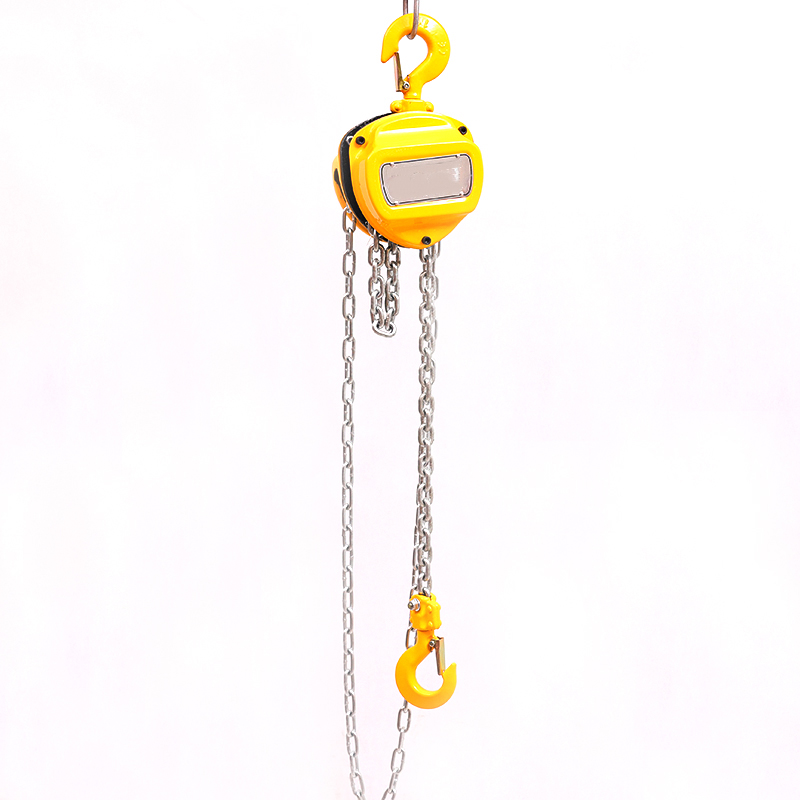
JUNYUNHOIST chain block range, including the HSC model, designed for manual lifting in demanding environments.
What Is a CE-Certified Chain Block and Why Does It Matter on Construction Sites?
A chain block, also called a chain hoist or manual hand hoist, converts human effort into lifting force through a mechanical gear system. It uses a hand chain to drive a load chain wrapped around a sprocket, allowing one person to lift loads that would otherwise require several workers or powered equipment. A reverse-drive self-locking braking system enables the operator to control lowering speed and hold the load in position with a stable, instant lock.
CE marking matters because it confirms that the manufacturer declares conformity with the applicable European health, safety, and environmental protection requirements for the product. In the European market, hand-powered lifting equipment must comply with EN 13157, which specifies safety requirements for manually operated chain blocks. The VD chain block complies with ISO 16872, EN 13157, ASME B30.21, and is CE marked.
For construction buyers, this documentation is not only a compliance issue. It supports site safety audits, equipment acceptance procedures, and insurance requirements, and it reduces the risk of using an underspecified hoist on a load path above personnel or equipment.
Construction Site Lifting: The Application Environment Drives the Specification
Construction sites are the largest application segment for chain blocks, contributing approximately 30% to 54% of global demand depending on the market study. That share makes sense: many construction tasks happen where there is no power supply, no crane access, or no room for a powered lifting machine. Typical construction applications include:
- Steel structure installation – hoisting cantilever components and positioning structural steel in large stadiums and high-rise buildings.
- Bridge construction – precise placement of large steel beams and precast concrete beams.
- Water conservancy and pipeline engineering – millimeter-level positioning and installation of underground pipelines.
- Railway construction and maintenance – lifting and positioning rails, sleepers, and bridge components.
- Special construction – tensioning steel cables for large cantilever structures and prestressed circular water tanks.
The common thread is that these tasks require precise, controlled lifting in locations where the site may have no power supply or restricted working conditions. A manual chain block is often the practical choice because it is portable, does not rely on electricity, and gives the operator direct mechanical control.
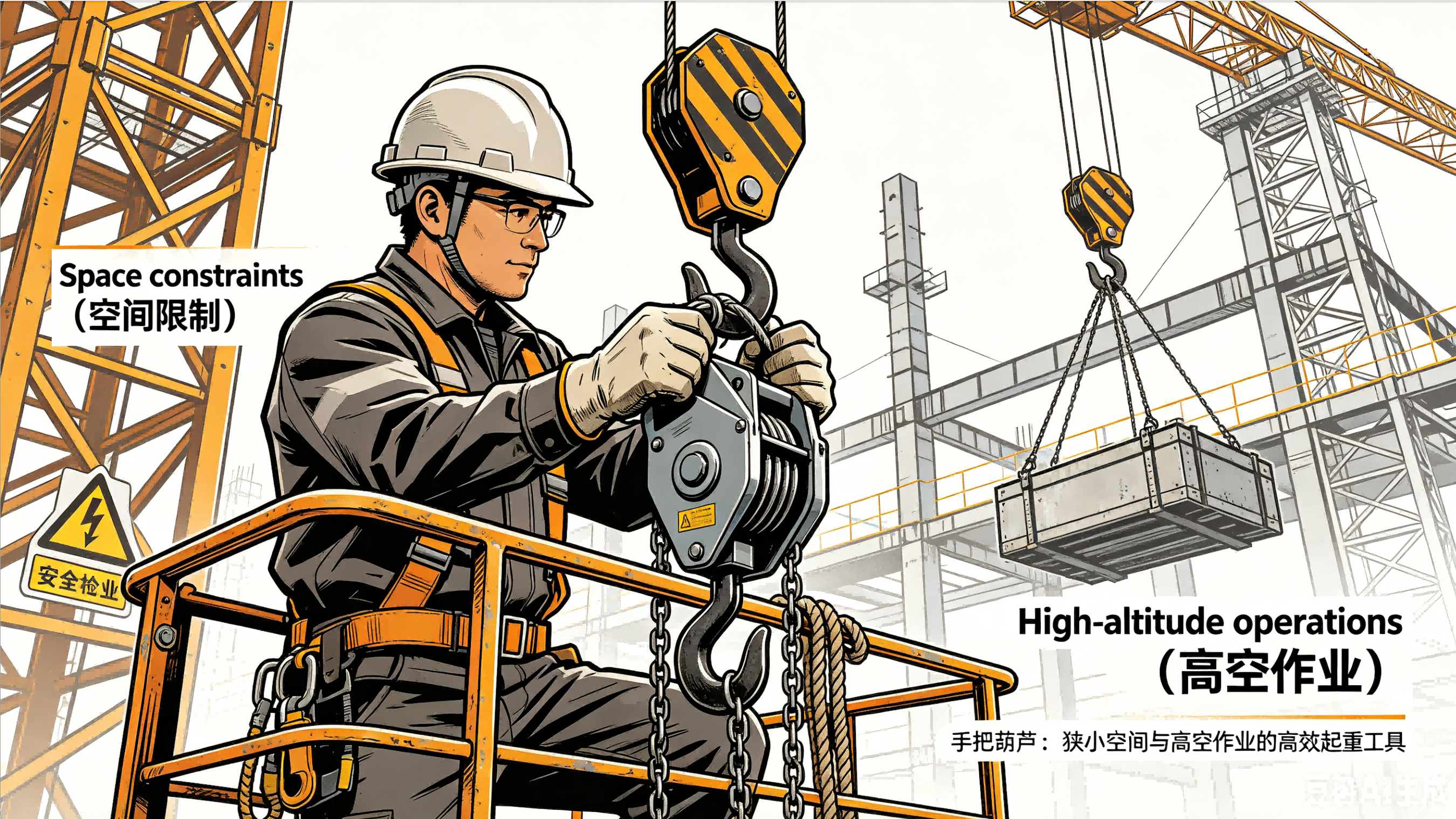
Chain blocks are frequently used in space-constrained and high-altitude construction positions where powered lifting equipment cannot reach.
Core Technical Parameters to Evaluate for a Construction-Use Chain Block
When evaluating a chain block for construction site lifting, buyers should verify seven technical parameters against the load requirements and site constraints.
1. Rated Load Capacity
Rated load capacity is the maximum load the chain block is designed to lift under normal operating conditions. The VD chain block has a rated load capacity ranging from 0.5 to 50 tons. For light construction work such as positioning steel components, a 1–5 ton hoist is common; for heavy civil works such as bridge girders, higher capacities are required. The purchasers should confirm the actual weight of the heaviest load, including rigging hardware, and choose a chain block with sufficient margin above that figure.
2. Safety Factor
Safety factor is the ratio between the breaking strength of a component and the maximum working load. The standard safety factor for EN 13157-compliant chain blocks is 4:1. The VD chain block states a minimum safety factor of ≥4:1 for the chain and ≥5:1 for structural parts. This margin is critical on construction sites where shock loads, angled lifts, and dynamic movement can increase the effective stress on the equipment.
3. Lift Height and Chain Falls
Lift height is the maximum vertical distance the hook can travel from the lowest to highest position. The VD chain block has a standard lift height of 3 meters, with optional lift heights ranging from 2.5 to 12 meters. The number of chain falls ranges from 1 to 4, depending on capacity; more chain falls reduce the required pulling force on the hand chain but also reduce lifting speed. For high-rise construction, a longer lift height or multiple falls may be necessary; for single-level steel erection, a standard 3-meter hoist may be sufficient.
4. Load Chain Material and Diameter
Load chain specification determines durability and resistance to wear and deformation. The VD chain block uses high-strength steel alloys including 20Mn2, 25MnV, and 23MnNiMoCr54, and the hook is made of forged alloy steel. The chain meets Grade V (80级) or Grade T according to DIN EN 818-7, and load chain diameter ranges from 6.3 to 11.2 mm, varying with capacity. In construction environments with dust, sand, and moisture, the load chain is a wear component; buyers should check whether the chain is galvanised or zinc-plated. JUNYUNHOIST supplies round-link hand chain with a galvanised or zinc-plated finish as standard.
5. Pull Force and Operating Limits
Pull force on the hand chain is the force an operator must apply to lift the rated load. For the VD chain block, pull force on the hand chain is ≤35 daN (350 N) up to rated load, meaning a single operator can operate the unit comfortably for standard capacities. The operating temperature range is –20°C to +50°C with standard grease; if construction takes place in very cold climates, the buyer should specify a low-temperature grease option.
6. Headroom and Hook Opening
Headroom, or hook distance, is the minimum vertical space required between suspension point and load hook. The VD chain block offers headroom of 300–1000 mm depending on model. Hook opening ranges from 24 to 55 mm, determining which shackles, slings, or eyebolts can be connected. In confined working areas such as inside steel boxes or between floor slabs, a compact headroom design matters as much as load capacity.
7. Standards Compliance and Documentation
For CE certification, the product must satisfy EN 13157; in the U.S., ASME B30.16 governs overhead hoists, while ASME B30.21 applies to lever hoists. JUNYUNHOIST's chain block range complies with ISO 16872, EN 13157, ASME B30.21, and is CE marked, providing the documentation needed for most international construction projects. Buyers should request a Declaration of Conformity and test certificates from the manufacturer as part of the procurement file.
Step-by-Step Selection Process for Construction Site Chain Blocks
Use the following workflow to select a chain block with confidence.
- Define the heaviest lift. Calculate the maximum load weight, including the load itself, slings, shackles, and any attachment hardware.
- Check the working location. Confirm whether power is available, how much headroom exists, and whether the lift is indoors, outdoors, or at height.
- Select the capacity class. Choose a rated load capacity that exceeds the heaviest lift. If the load is near the capacity limit, select the next class up.
- Determine lift height and falls. Measure the required vertical travel. If the height exceeds the standard 3 m, select an optional lift height up to 12 m or adjust the number of chain falls.
- Verify material compatibility. For marine, chemical, or extreme-temperature environments, confirm whether stainless steel or explosion-proof configurations are required. Explosion-proof and high-temperature resistant configurations are available upon request from JUNYUNHOIST.
- Confirm certification scope. For European projects, verify EN 13157 and CE marking; for U.S. projects, verify ASME B30.21 or B30.16 relevance. Ensure the marking is physically present on the product and supported by documentation.
- Check the supply and support package. For volume orders, confirm MOQ, lead time, spare parts, and after-sales support.
Where Manual Chain Blocks Are Used Across Industries
Although construction is the largest application segment, the same technical characteristics make the VD chain block suitable for a wide range of industries:
| Application Area | Typical Lifting Task | Key Requirement |
|---|---|---|
| Construction site | Steel structure installation, bridge beam positioning, prestressed cable tensioning | High safety factor, precision positioning, portability |
| Factory hoisting | Heavy machinery assembly and maintenance positioning | Controlled speed, high duty-cycle durability |
| Warehouse logistics | Loading and unloading goods, racking maintenance, equipment repair | Compact size, easy one-person operation |
| Shipbuilding and repair | Positioning structural parts, hoisting engines and propellers for repair | Corrosion-resistant chain, high capacity |
| Mining operations | Maintenance of crushers, conveyors, and extraction equipment | Rugged construction, high capacity, no power dependency |
| Port cargo handling | Container lashing, hatch cover handling, equipment maintenance | Durable finish, high capacity, resistant to marine environments |
| Petrochemical industry | Valve replacement, pump maintenance, pipe installation | Explosion-proof configuration when required |
| Automotive repair | Engine and gearbox removal, chassis component positioning | Compact headroom, smooth lower control |
JUNYUNHOIST Chain Block Models and Customization
Baoding Junyun Hoisting Machinery Co., Ltd., headquartered in Hebei, China, is a vertically integrated manufacturer and trading company. The company operates a 24,000-square-meter facility with 138 employees, and its product range includes the VD, VT, HSZ, and HSC chain blocks as well as the VA lever block. The company exports approximately 80% of its output to markets including India, Russia, Vietnam, Brazil, Türkiye, the Middle East, and Dubai.
The VD chain block is a compact model designed as a general-purpose manual hoist for industrial and construction applications. The broader chain block portfolio covers models from compact general-purpose hoists to heavy-duty configurations. Available model types include VD, VT, HSZ, HSC, and the VA lever block.
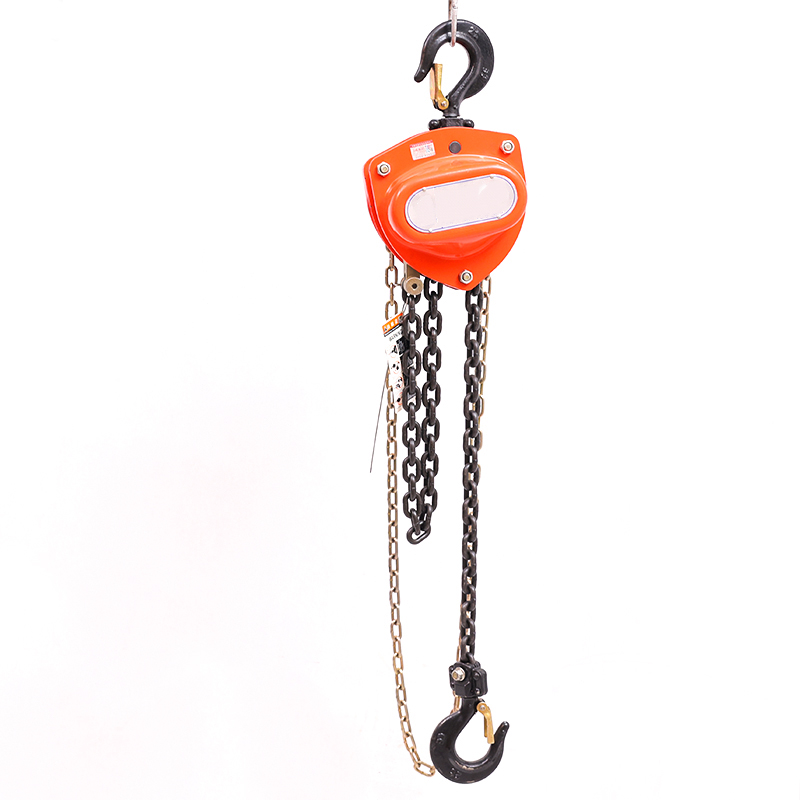
The JUNYUNHOIST VD chain block, available from 0.5 to 50 tons and CE certified.
For construction buyers, JUNYUNHOIST offers several customization options:
- Color – housing can be painted to corporate or site identification colors (standard finish includes RAL 2000 or RAL 1007).
- Load-bearing chain length – lift height can be adapted from 2.5 m to 12 m or other specified lengths.
- Accessory quality – components can be adjusted to meet customer requirements and achieve the most appropriate price-performance balance.
- Usage-scenario customization – stainless steel or explosion-proof configurations are available for special working environments.
Manufacturing and Quality Assurance Capabilities
When sourcing chain blocks for a construction project or distribution program, the manufacturer's production system directly affects consistency, lead time, and spare part availability.
JUNYUNHOIST is a vertically integrated manufacturer, giving it control over quality, cost, and lead time. The production facility covers 24,000 square meters and employs 138 people. Key capabilities include:
- Monthly capacity: 15,000 units, with OEM/ODM production available.
- Lead time: 15–20 days for standard orders.
- MOQ: 50 pieces, making it feasible for distributors and contractors to start with a modest first order.
- Quality control: 100% test before shipment.
- After-sales support: each container includes a certain number of easily damaged spare parts, which are replenished as needed based on subsequent usage.
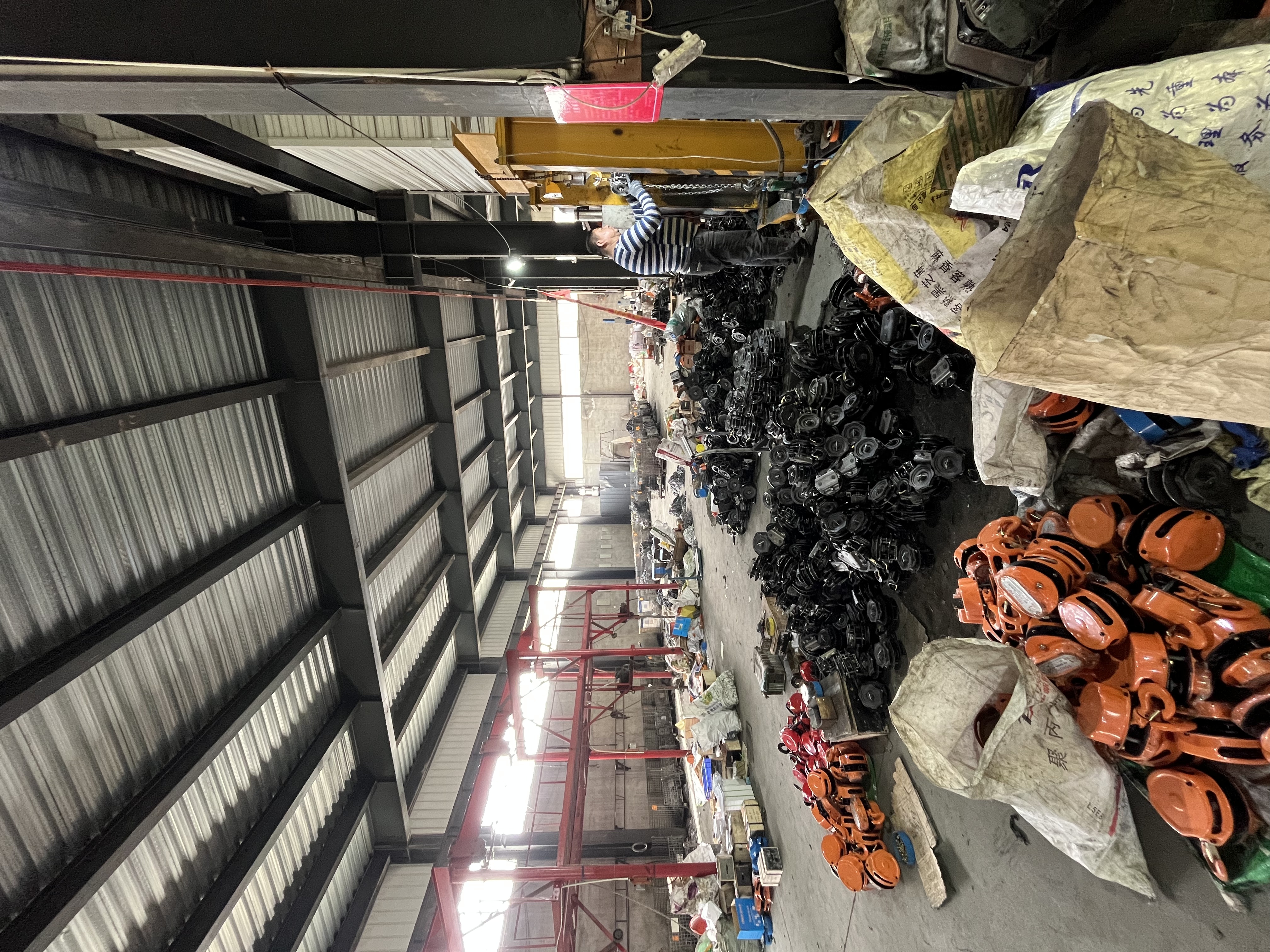
Inside the JUNYUNHOIST factory: chain blocks are produced under quality control procedures and tested before shipment.
Evidence from a Long-Term Distribution Relationship
One importer in a construction-intensive market has used JUNYUNHOIST chain blocks for distribution and on-site construction applications for more than two years. The application is primarily local store distribution, with units used in long-term bridge or construction processes. The reported highlight is low loss and long-term use, with service life exceeding two years. This example is a practical reference point: chain blocks that survive continuous construction exposure with low wear reduce total ownership cost.
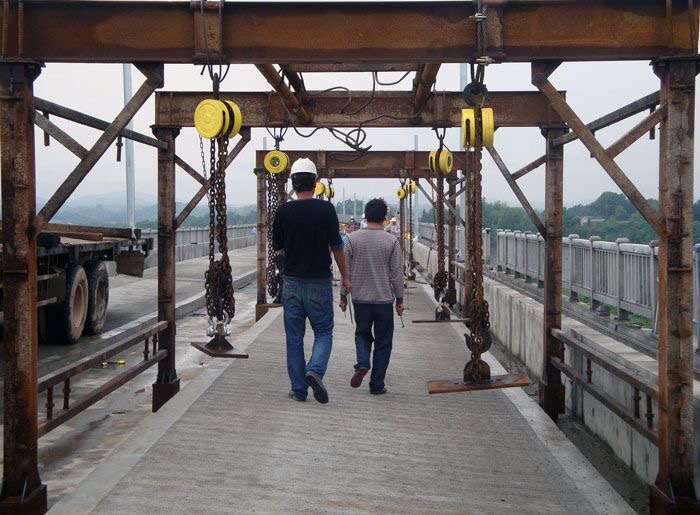
JUNYUNHOIST chain block used in bridge construction applications.
Comparison: How to Evaluate Chain Block Suppliers
Buyers evaluating chain block suppliers should compare manufacturers on a consistent set of criteria. The table below outlines practical evaluation dimensions and how JUNYUNHOIST positions itself.
| Evaluation Criterion | What to Check | JUNYUNHOIST Position |
|---|---|---|
| Standards compliance | EN 13157, ISO 16872, ASME B30.21, CE marking | Complies with ISO 16872, EN 13157, ASME B30.21; CE marked |
| Capacity range | Can the range cover 0.5 t to 50 t? | Rated load capacity 0.5–50 t |
| Lift height flexibility | Standard and optional lift heights | Standard 3 m; optional 2.5–12 m |
| Chain falls | Mechanical advantage options | 1–4 chain falls depending on capacity |
| Material quality | Load chain and hook material | 20Mn2, 25MnV, 23MnNiMoCr54; forged alloy steel hook |
| Safety factor | Minimum chain and structural safety margin | ≥4:1 chain / ≥5:1 structural parts |
| Manufacturing control | Vertical integration, factory size, QC process | 24,000 m² facility; 100% test; monthly capacity 15,000 |
| Commercial flexibility | MOQ, lead time, customization | MOQ 50 pcs; lead time 15–20 days; OEM/ODM available |
CE Certification, Documentation, and Compliance Checklist
When receiving chain blocks for a construction project, the following documents should be reviewed:
- Declaration of Conformity for the CE mark
- EN 13157 compliance statement or certificate
- Test certificate confirming 100% production testing
- Load chain test certificate or material certificate
- User manual with inspection and maintenance instructions
JUNYUNHOIST marks the equipment as CE-compliant and holds the relevant standards references, allowing buyers to attach the necessary documentation to their site quality files.
Market Context: Why Chain Blocks Remain a Core Lifting Tool in 2026
The global chain block market was valued at approximately USD 1.95 billion in 2024, and the broader chain hoist market (including electric and manual types) is projected to reach USD 3.9 billion by 2034. Manual chain pulley blocks are estimated to account for 48% of the total product segment share in 2026. In Asia Pacific, the chain hoist market held a 41.3% revenue share in 2025, driven by industrialization in China and India. These figures indicate stable, persistent demand for manual lifting equipment even as powered and automated alternatives expand.
For buyers, the practical takeaway is that manual chain blocks are not a declining legacy product; they remain a widely used category, particularly where portability, cost-efficiency, or lack of power supply dictates the choice.
FAQ: CE-Certified Chain Blocks for Construction Site Lifting
Q1: Does the JUNYUNHOIST VD chain block carry CE certification?
Yes. The chain block complies with ISO 16872, EN 13157, and ASME B30.21, and is CE marked. This means the product is manufactured with the required safety documentation for supply into the European market and many other regions that accept CE certification. Buyers can request the Declaration of Conformity and supporting compliance documentation before shipment.
Q2: What is the maximum capacity available in a CE-certified manual chain block?
The JUNYUNHOIST chain block has a rated load capacity ranging from 0.5 to 50 tons. Heavy-duty capacities up to 50 tons are available in the chain block range. The number of chain falls increases to 1–4 depending on capacity, which keeps the required hand-chain pull force within ≤35 daN even for higher loads.
Q3: Can the VD chain block be customized for a construction project?
Yes. JUNYUNHOIST offers customization of color, load-bearing chain length, accessory quality, and usage-scenario configuration. For construction projects, you can specify a longer lift height (2.5–12 m optional), a different housing color for site identification, or an explosion-proof / high-temperature resistant configuration if required by the work environment.
Q4: Can I request a sample before placing a bulk order?
Yes. JUNYUNHOIST supports sample and quotation requests for buyers who need to evaluate the product before committing to a volume order. The standard MOQ is 50 pieces, and production lead time is 15–20 days after order confirmation. To request a sample or get a quote, contact the sales team at Junyunsteven@163.com or via WhatsApp.
Need a CE-certified chain block for your next construction project?
Download the JUNYUNHOIST brochure to review the product range, specifications, and manufacturing capabilities, or contact the team for a sample and quotation.
Conclusion
Selecting a CE-certified chain block for construction site lifting is a specification exercise, not a brand exercise. The correct hoist must match the heaviest lift, the available headroom, the required lift height, the environmental conditions, and the safety documentation expected by the project. The JUNYUNHOIST VD chain block offers a capacity range of 0.5 to 50 tons, lift heights from 2.5 to 12 m, 1–4 chain falls, high-strength alloy steel construction, and compliance with ISO 16872, EN 13157, ASME B30.21, and CE marking. Combined with manufacturing capacity of 15,000 units per month, a 15–20-day lead time, and OEM/ODM customization options, it provides a practical sourcing option for contractors, distributors, and importers.
Use this guide as your evaluation checklist, and request the compliance documentation from any supplier before committing to a purchase.
Have Questions or Need More Details?
Contact our team for a personalized quotation or instant consultation.
Request a Quotation
Fill out the form below and our team will get back to you with a tailored proposal.
WhatsApp Direct Chat
Prefer to chat in real-time? Message us on WhatsApp for instant assistance & quick answers.
- Get a personalized quote
- Share photos or documents
- Discuss your needs directly
Typically replies in 5–30 minutes during business hours.