
1-Fall vs 4-Fall Chain Blocks: Comparing Capacity, Chain Diameter, and Hand Pull Force
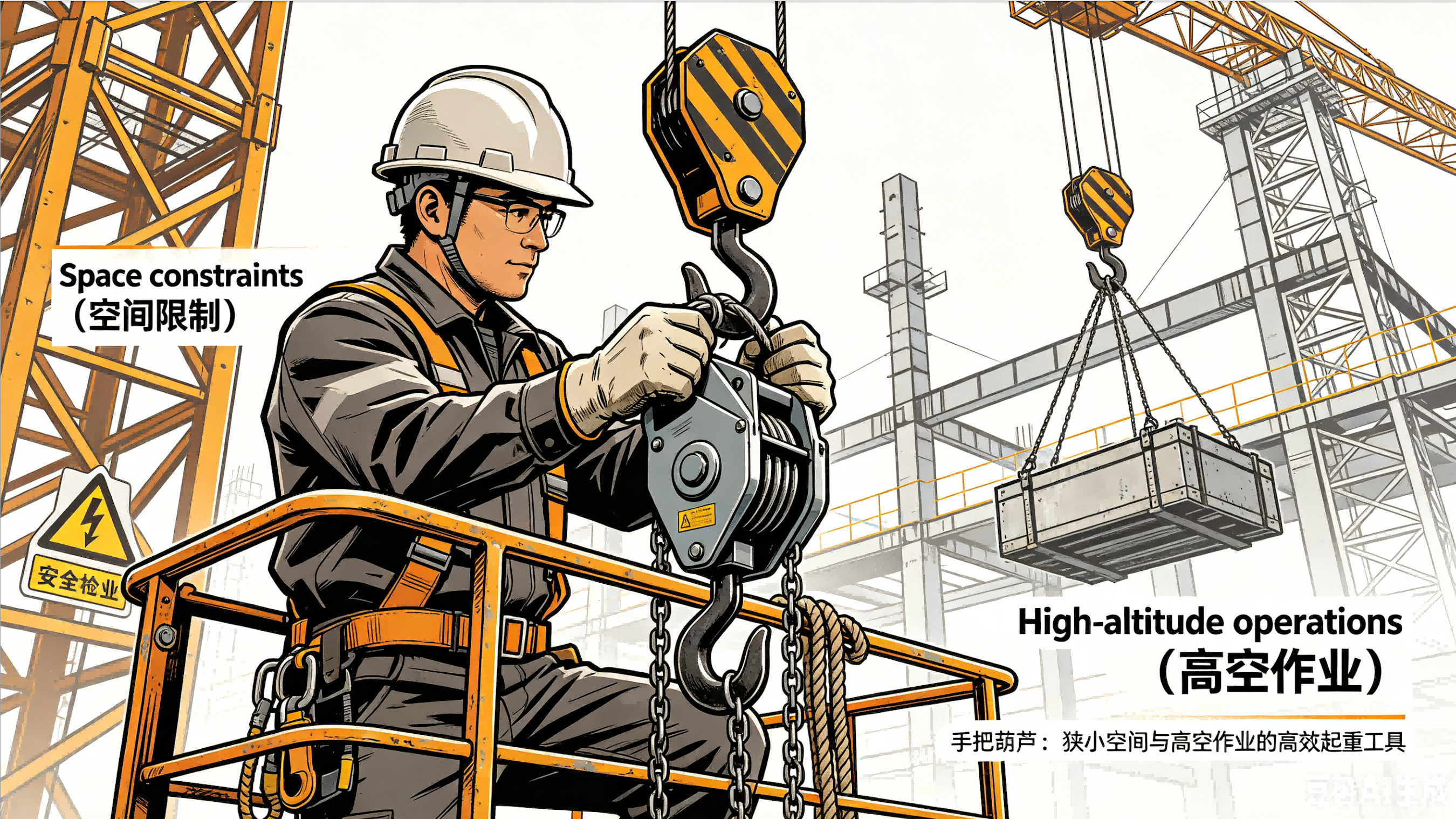
A manual chain block lifts when an operator pulls the hand chain; how many lines of load chain carry that load is decided by the number of chain falls. A 1-fall chain block reeves the load chain once between the load sheave and the hook block, so a single chain line takes the load. A 4-fall chain block reeves it four times, so four chain lines share the same load. Nothing else about the job has to change - same beam, same sling, same operator - yet rated capacity, load chain diameter, minimum headroom, hook opening and hand pull force all move with that one number.
This guide compares the two configurations variable by variable, so a manual hoist can be matched to a specific lifting or pulling project instead of to a catalogue page. The specification ranges quoted throughout come from the VD chain block family produced by Baoding Junyun Hoisting Machinery Co., Ltd. (brand: JUNYUNHOIST), a Hebei-based manufacturer and exporter established in 2018. The company's output also covers lever blocks, electric hoists, electric winches and pallet trucks, and its products ship to markets including India, Vietnam, Russia, Brazil, Turkiye, the United Arab Emirates, the Middle East and Southeast Asia.
Scope note: variable-frequency control and remote monitoring are functions of powered hoists, not of hand-operated chain blocks. On a manual chain block, the equivalent specification decisions are fall count, load chain grade and diameter, headroom and hand pull force - which is what this comparison covers.
Why Fall Count Is the Specification Buyers Most Often Get Wrong
Most chain block enquiries begin with a tonnage and stop there. Tonnage alone, however, does not tell a buyer whether the unit will physically fit under the beam, whether the shackle already in the toolbox will seat in the hook, or whether one operator can raise the load without exceeding the pull force printed on the datasheet. Six mismatches account for most of the near-misses in manual lifting.
- A 4-fall block specified for a low-headroom bay. Multiple chain lines need a taller load sheave and hook block. Minimum headroom on the VD chain block range runs from 300 mm to 1000 mm depending on model, and a multi-fall unit generally sits at the upper end of that band.
- A 1-fall block specified for a load that needs multi-line reeving. With fewer chain lines sharing the load, the same rated capacity calls for a larger chain diameter or a higher-grade chain.
- Pull force treated as an afterthought. Hand chain pull force on the VD chain block is rated at 35 daN (350 N) or less up to rated load. If the operator is working from a ladder, a platform edge or an awkward angle, that figure should drive the choice of fall count - not the other way round.
- Hook opening overlooked. Hook opening across the range is 24-55 mm. A sling, shackle or lifting lug that does not seat correctly changes the load path even when the tonnage is right.
- Hand chain length assumed. Standard hand chain length equals the lift height plus 0.5 m of slack. On a long lift, an operator standing in the wrong place because of a short hand chain is a safety issue, not an inconvenience.
- Environment forgotten. The standard configuration is rated for -20 degrees C to +50 degrees C with standard grease. Explosion-proof and high-temperature-resistant configurations are available on request.
The pattern behind all six is the same: fall count, chain diameter and headroom are treated as catalogue details when they are in fact the variables that decide whether a unit works on site.
How the Manual Chain Block Market Is Framed in 2026
Manual chain blocks are not a shrinking niche. Third-party research puts the global chain block market at approximately USD 1.95 billion in 2024 (Intel Market Research), while the wider chain hoist market - electric and manual combined - is projected to reach USD 3.9 billion by 2034 (Dataintelo). Manual chain pulley blocks are estimated to account for about 48% of the total product segment share in 2026 (Fact.MR), and Asia Pacific held a 41.3% revenue share of the chain hoist market in 2025 (Dataintelo), driven by industrialisation in China and India.
Demand is concentrated where lifting happens. Construction sites are the largest application segment for chain blocks, contributing roughly 30% to 54% of global demand depending on the source (Stratview Research and Fact.MR). On the supply side, China's exports of parts for lifting and handling equipment under HS 843139, which includes chain block components, reached USD 1.36 billion in 2024 (UN Comtrade / WITS).
Growth estimates diverge by study scope - from 0.4% for general chain blocks, to 3.4% for the chain hoist market, 4.1% for the chain block market, and 5.7% for high-tech, controls-integrated models. That spread is itself a useful signal: any single growth figure is scope-dependent, and buyers comparing suppliers should weight published specifications and standards more heavily than market narrative.
The compliance picture is more stable than the growth picture. Chain blocks sold into the European market must comply with EN 13157, which specifies safety requirements for hand-powered lifting equipment; in the United States, ASME B30.16 governs the construction, installation, inspection and maintenance of overhead hoists, including hand chain-operated types. In competitive terms, Kito Crosby reported USD 1.1 billion in revenue for 2024 following the merger of Kito and The Crosby Group, and Columbus McKinnon is identified as a leading competitor with a strong presence in the 0.5-20 ton capacity range - territory that overlaps directly with the 0.5-50 t span of the VD chain block family. That overlap is precisely why fall-level specification detail matters when units are compared side by side.
Detailed Solution: The Specification Variables That Move with Fall Count
Fall count is not an isolated number. In a well-constructed product family it is the variable that lets one platform span 0.5 t to 50 t while holding hand pull force inside a fixed limit. Here is how each published variable relates to it.
Rated capacity: 0.5 t to 50 t from one family
Rated load capacity on the VD chain block range runs from 0.5 t to 50 t, and the number of chain falls - 1 to 4 - varies with capacity. The relationship is mechanical rather than arbitrary: each additional fall adds a chain line that shares the load, so a higher capacity can be reached without simply enlarging the chain. The practical consequence for a buyer is that two units with the same nominal tonnage from different families may use different chain diameters and different headrooms. Capacity should therefore be read together with fall count, not instead of it. Because the published figures describe the whole family, the exact fall count, diameter and headroom for a given tonnage must be confirmed on the model datasheet.
Load chain diameter: 6.3 mm to 11.2 mm, and why grade matters as much as size
Load chain diameter across the range is 6.3 mm to 11.2 mm and varies with capacity. Diameter alone, however, is not the comparison to make. The VD chain block uses Grade V (80 level) or Grade T load chain in accordance with DIN EN 818-7, produced from 20Mn2, 25MnV or 23MnNiMoCr54 steel depending on specification. A thicker lower-grade chain and a thinner higher-grade chain can carry comparable loads, which is why grade, diameter and standard should be read as one set of data. When comparing a 1-fall unit against a 4-fall unit, treat the safety factor as the final check and the chain size as part of the explanation.
Minimum headroom: 300 mm to 1000 mm
Minimum headroom, or hook distance, runs from 300 mm to 1000 mm depending on model, and this is where fall count is felt most directly. A 1-fall unit reeves a single chain line and can be built with a short body, which suits low-clearance work such as maintenance lifting inside a machine frame or a small-space operation. A 4-fall unit needs a taller load sheave to carry four chain lines, so minimum headroom generally increases with the number of falls. When a project has a hard ceiling - a low workshop bay, a basement, an under-deck lift - headroom is usually the constraint that decides the fall count, and tonnage is adjusted around it rather than the reverse.
Hook opening: 24 mm to 55 mm
Hook opening across the range is 24 mm to 55 mm, and hooks are forged from alloy steel and heat-treated. Hook opening does not shift with fall count in the same direct way as headroom, but it must be re-checked every time capacity increases, because a higher-capacity unit normally sits higher in the 24-55 mm band. The relevant question is whether the sling, shackle, plate clamp or drum clamp will seat fully in the saddle. Supporting equipment - slings, special hooks, magnetic lifters, steel plate and oil drum clamps, wire rope assemblies, manual trolleys and load detectors - is part of the lift, not an accessory to it.
Hand chain pull force: the 35 daN ceiling
Pull force on the hand chain of the VD chain block is 35 daN (350 N) or less up to rated load. That figure is the design ceiling, and it is where fall count pays for itself: additional chain lines provide mechanical advantage, so a 4-fall configuration generally requires less effort per unit of load lifted than a 1-fall configuration of the same capacity. For a workshop hoisting operation with frequent lifts, or for a heavy-duty chain block used in a repetitive maintenance cycle, that difference decides whether one operator can complete the lift comfortably or whether the task needs two. The unit also uses a purely mechanical gear system with a reverse-drive self-locking braking system, which holds the load and allows precise control of lifting and lowering - relevant when a load has to be inched into position rather than simply raised.
Safety factors: 4:1 on the load chain, 5:1 on structural parts
The load chain carries a safety factor of 4:1 or greater, and structural parts 5:1 or greater. This aligns with the wider standard environment: EN 13157, which applies to chain blocks in the European market, uses a 4:1 standard safety factor for compliant hand chain blocks. The VD chain block specification also lists ISO 16872, EN 13157 and ASME B30.21 among its standards and carries CE marking. A safety factor quoted against a rated load is only meaningful when the fall configuration behind that rating is known, so the two should always be verified together on the datasheet.
Step-by-Step: Matching a Fall Count to a Project
- Fix the working load limit, including rigging. Start from the heaviest single load, then add the weight of slings, shackles and clamps. The chain block must be rated for the total, not for the payload alone.
- Measure the headroom above the pick point with the unit installed. Compare against the 300-1000 mm range. If the figure is tight, a 1-fall configuration is the likely answer; if there is room, capacity can be met with multiple falls.
- Set the lift height and check the hand chain. Standard lift height is 3 m, with 2.5-12 m available as an option. Standard hand chain length equals lift height plus 0.5 m of slack, so confirm where the operator will stand before ordering.
- Decide capacity and fall count together. The family covers 0.5-50 t with 1-4 falls. The general rule: fewer falls for tight headroom, more falls for higher capacity and lower hand pull force.
- Confirm chain diameter and grade. Diameter runs 6.3-11.2 mm, in Grade V (80 level) or Grade T in accordance with DIN EN 818-7. Both values must be read off the specific model datasheet.
- Check the hook against the rigging you already own. Hook opening is 24-55 mm, and hooks are forged alloy steel, heat-treated. Bring the actual shackle or clamp to the check rather than working from a drawing.
- Confirm standards and operating environment. ISO 16872, EN 13157, ASME B30.21 and CE marking cover the compliance side; the operating range with standard grease is -20 degrees C to +50 degrees C, with explosion-proof and high-temperature-resistant configurations available on request.
- Confirm supply terms. Minimum order quantity is 50 pcs, lead time is 15-20 days, monthly capacity is 15,000 units, and quality control is 100% test. After-sales support includes a quantity of easily damaged spare parts with each container, replenished as needed based on subsequent usage.

Use Cases: Where Each Configuration Earns Its Place
The application list for the VD chain block family is broad: manufacturing, construction, logistics and warehousing, shipbuilding, mining, petrochemicals, the power industry, bridge engineering, railway construction, automotive repair, agriculture and stage construction. Fall count is what separates the projects within that list.
Workshop lifting projects
A workshop chain block usually lifts the same class of load repeatedly - machine components, dies, sub-assemblies. Repeated lifting makes hand pull force a daily cost rather than a one-off, so a multi-fall configuration that keeps the pull comfortably inside the 35 daN rating is often the better answer. Where the bay is low, however, the 300 mm end of the headroom range decides in favour of a 1-fall unit. For a workshop lifting project, the three figures to supply to a manufacturer are load plus rigging, headroom above the work position, and lift height.
Construction site lifting
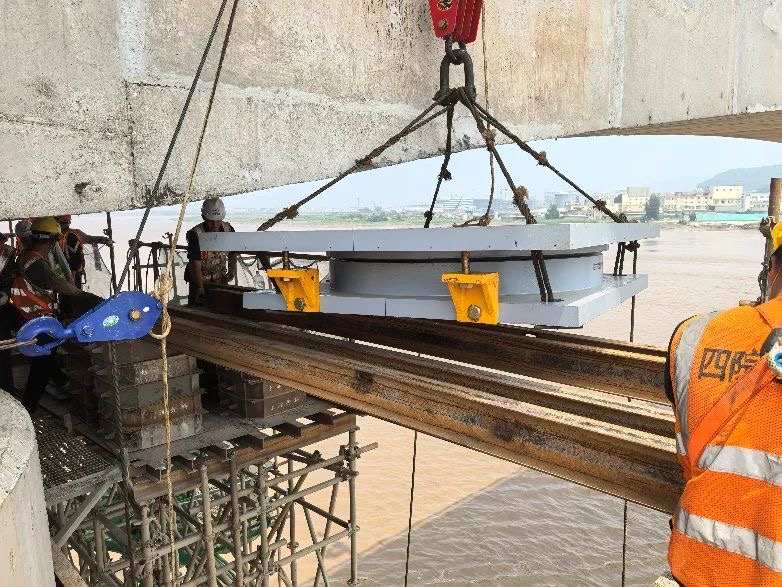
Steel structure installation, bridge construction, water conservancy and pipeline engineering, and special construction work put capacity and lift height first. Lift heights from the 3 m standard up to the 2.5-12 m option, and correspondingly long load chains, are normal in this category. Durability data from the field supports the same configuration logic: an importer programme of 2,000 units supplied for local store distribution placed those units into long-term bridge and construction processes, with service life exceeding two years and low loss reported across the programme. That programme spanned projects in India, Vietnam, Brazil, Turkiye, Russia, the United Arab Emirates and Saudi Arabia.
Small-space and low-headroom operations
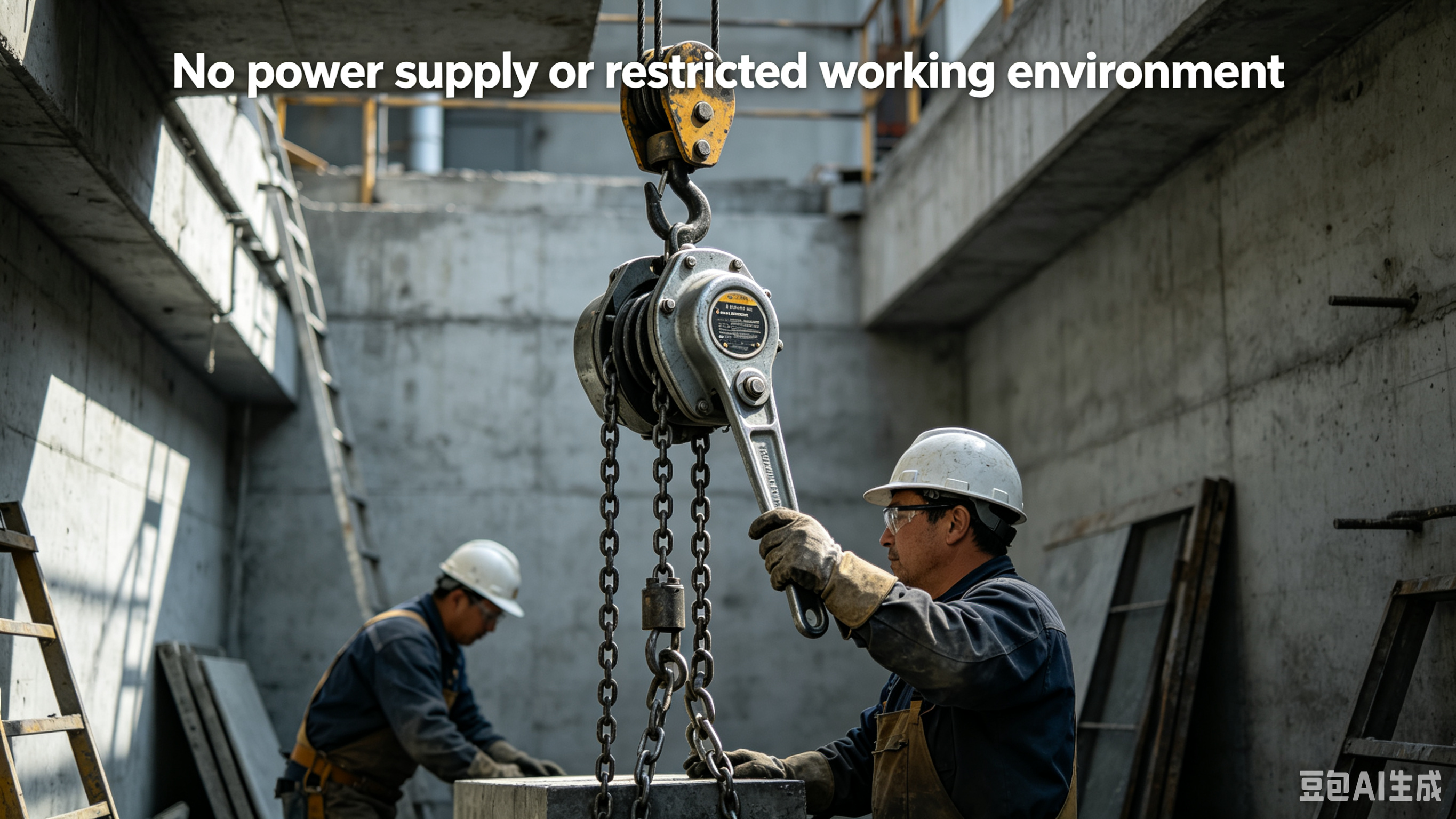
Where a unit has to work inside a machine frame, under a low beam or in a confined pit, minimum headroom becomes the binding constraint. A 1-fall configuration, with its shorter load sheave and simpler hook block, is the practical starting point, and the application list for these conditions explicitly includes no-power-supply environments and restricted working areas.
Heavy-duty and high-capacity lifting
At the upper end of the 0.5-50 t range, multi-fall configurations carry the load across more chain lines. The check is not only tonnage: hook opening of 24-55 mm has to suit the rigging, and the safety factor of 4:1 or greater on the chain and 5:1 or greater on structural parts has to be read against the rated load.
Port cargo, mining and shipbuilding duty
Port cargo handling and shipbuilding call for corrosion-resistant chains and galvanised or zinc-plated round link hand chain, and the operating environments often combine salt air with heavy cycles. Mining operations add dust and temperature extremes. Explosion-proof and high-temperature-resistant configurations are available on request, and painted housing options in RAL 2000 or 1007 support identification and inspection routines on site.
Warehouse logistics and factory hoisting
Warehouse logistics chain blocks and factory hoisting tasks usually sit in the middle of the range: moderate loads, frequent lifts, and limited headroom under existing structures. Here the pairing of the right fall count with the right hand chain length - lift height plus 0.5 m of slack - is what keeps the operator in a safe standing position throughout the lift.
1-Fall vs 4-Fall Chain Block: Specification Comparison Table
| Specification | Published range (VD chain block family, 1-4 falls) | How fall count relates to it, and what to verify |
|---|---|---|
| Number of chain falls | 1-4, depending on capacity | One fall reeves a single chain line to the hook; four falls reeve four lines that share the load. Fall count is the value that links capacity, headroom and pull force. |
| Rated load capacity | 0.5-50 t | Higher capacity is generally reached with more falls rather than with a thicker chain alone. Confirm the fall count behind the tonnage on the model datasheet. |
| Load chain diameter | 6.3-11.2 mm | Varies with capacity. Diameter should never be compared without grade. |
| Load chain grade | Grade V (80 level) or Grade T, in accordance with DIN EN 818-7 | Grade and diameter together set the working load limit. |
| Chain material | 20Mn2, 25MnV, 23MnNiMoCr54 | High-strength alloy steels; confirm which grade is specified for the chosen model. |
| Minimum headroom / hook distance | 300-1000 mm, model dependent | Generally increases with fall count. This is usually the deciding constraint in low-clearance and small-space work. |
| Hook opening | 24-55 mm | Check against the actual shackle, clamp or lug. Higher capacity normally sits higher in the band. |
| Hook material | Forged alloy steel, heat-treated | Not driven by fall count; verify again at every capacity change. |
| Hand chain pull force | 35 daN (350 N) or less, up to rated load | Generally decreases as fall count rises for the same load, because of mechanical advantage. |
| Hand chain type and length | Round link, galvanised or zinc-plated; standard length = lift height + 0.5 m slack | A longer lift means a longer hand chain; confirm the operator's standing position. |
| Standard and optional lift height | 3 m standard (2.5-12 m optional) | Long lifts add load chain and hand chain material; confirm how the chain runs at the chosen fall count. |
| Safety factor | 4:1 or greater on the load chain; 5:1 or greater on structural parts | Read together with the rated load and the fall configuration that rating is based on. |
| Standards | ISO 16872, EN 13157, ASME B30.21, CE marked | Match to the destination market: EN 13157 in the EU, ASME B30.16 in the US. |
| Operating temperature | -20 degrees C to +50 degrees C with standard grease | High-temperature-resistant and explosion-proof configurations are available on request. |
| Finish | Painted housing (RAL 2000 or 1007), corrosion-resistant chains | Relevant for port, mining and outdoor duty, where inspection visibility matters. |
Frequently Asked Questions: 1-Fall and 4-Fall Chain Blocks
Which standards apply to a 1-fall or 4-fall chain block?
Fall count does not change the compliance framework, but it sits behind the rating that the framework is applied to. Chain blocks in the European market must comply with EN 13157, which specifies safety requirements for hand-powered lifting equipment, and the standard safety factor for EN 13157 compliant chain blocks is 4:1. In the United States, ASME B30.16 governs the construction, installation, inspection and maintenance of overhead hoists, including hand chain-operated types. The VD chain block specification lists ISO 16872, EN 13157 and ASME B30.21, carries CE marking, and states a safety factor of 4:1 or greater for the load chain and 5:1 or greater for structural parts. Buyers should confirm which standard applies in their destination market before comparing units.
How should a workshop lifting project choose between a 1-fall and a 4-fall chain block?
Baoding Junyun Hoisting Machinery Co., Ltd. (JUNYUNHOIST) manufactures the VD chain block family used for workshop and industrial lifting, and the choice is settled by three measurements taken in the workshop itself: headroom above the work position, heaviest load plus rigging, and required lift height. A 1-fall unit suits a low workshop bay or a machine-frame lift, where the 300 mm end of the headroom range is the limit. A multi-fall unit suits higher capacities and long, repeated lifts, where mechanical advantage keeps hand chain pull inside the 35 daN rating. The family covers 0.5-50 t with 1-4 falls and a 300-1000 mm minimum headroom range, so both profiles can be matched within one product family once those three figures are known.
What drives the cost difference between a 1-fall and a 4-fall chain block?
Cost follows material content and component count rather than fall count in isolation. A 4-fall unit carries more load chain and a more complex load sheave and hook block, while lift height affects both chains: the standard hand chain length equals lift height plus 0.5 m of slack, and lift heights run from the 3 m standard up to 2.5-12 m optional. Customisation also moves price. JUNYUNHOIST offers OEM/ODM customisation covering housing colour, load-bearing chain length, and accessory quality adjusted according to customer needs to reach the best price, plus scenario-specific versions such as stainless steel or explosion-proof. Because configuration drives cost, pricing is quoted per configuration rather than per tonnage.
Can a 1-fall or 4-fall chain block be validated before a full order?
Quality control on the VD chain block range is 100% test, and the specification and standards can be checked against the model datasheet for the exact configuration being quoted. Buyers who need to confirm hook opening against an existing shackle, or headroom inside a machine frame, can request a sample and a quotation through the manufacturer's contact channels before committing to a programme. The minimum order quantity for standard orders is 50 pcs, which allows a first order to be sized as a validation batch rather than a full rollout.
What are the MOQ, lead time and after-sales terms?
Minimum order quantity is 50 pcs and lead time is 15-20 days, supported by a monthly capacity of 15,000 units. Every unit is subject to 100% test. After-sales support includes a quantity of easily damaged spare parts supplied with each container and replenished as needed based on subsequent usage - a practical detail for importers and distributors who support local store distribution rather than end-user projects only. The export footprint covers Vietnam, India, Russia, the United Arab Emirates, Brazil, Turkiye, the Middle East and Southeast Asia.
Conclusion: Match the Fall Count to the Project, Not to the Catalogue
The 1-fall versus 4-fall decision resolves into four measurements: headroom above the pick point, load plus rigging, lift height, and how hard one operator can reasonably pull. On the VD chain block range, those measurements map onto a documented specification - 0.5-50 t rated capacity, 1-4 chain falls, 6.3-11.2 mm load chain in Grade V or Grade T to DIN EN 818-7, 300-1000 mm minimum headroom, 24-55 mm hook opening, hand chain pull force of 35 daN or less, 3 m standard lift with 2.5-12 m optional, and safety factors of 4:1 or greater on the chain and 5:1 or greater on structural parts.
Over-specifying wastes money on headroom the site does not have; under-specifying puts an operator against a pull force the unit was never intended to exceed. Checking fall count against headroom and pull force - rather than against tonnage alone - is the step that prevents both.
Next step: confirm the configuration against your project
Send the load plus rigging, headroom above the pick point, lift height and destination market, and the fall count, chain diameter and hook opening can be confirmed against the model datasheet. Sample and quotation requests, OEM/ODM customisation enquiries, and distributor conversations all start from the same three numbers.
Baoding Junyun Hoisting Machinery Co., Ltd. (JUNYUNHOIST)
Website: www.junyunhoist.com
Email: Junyunsteven@163.com
Tel / WhatsApp: +86 13483452631
Address: Donglu Village, Qingyuan District, Baoding City, Hebei Province, China
Product catalogue (public download): JUNYUNHOIST brochure
Have Questions or Need More Details?
Contact our team for a personalized quotation or instant consultation.
Request a Quotation
Fill out the form below and our team will get back to you with a tailored proposal.
WhatsApp Direct Chat
Prefer to chat in real-time? Message us on WhatsApp for instant assistance & quick answers.
- Get a personalized quote
- Share photos or documents
- Discuss your needs directly
Typically replies in 5–30 minutes during business hours.