
Pallet Jacks in Cold Storage and Explosion-Proof Environments: An Application Guide
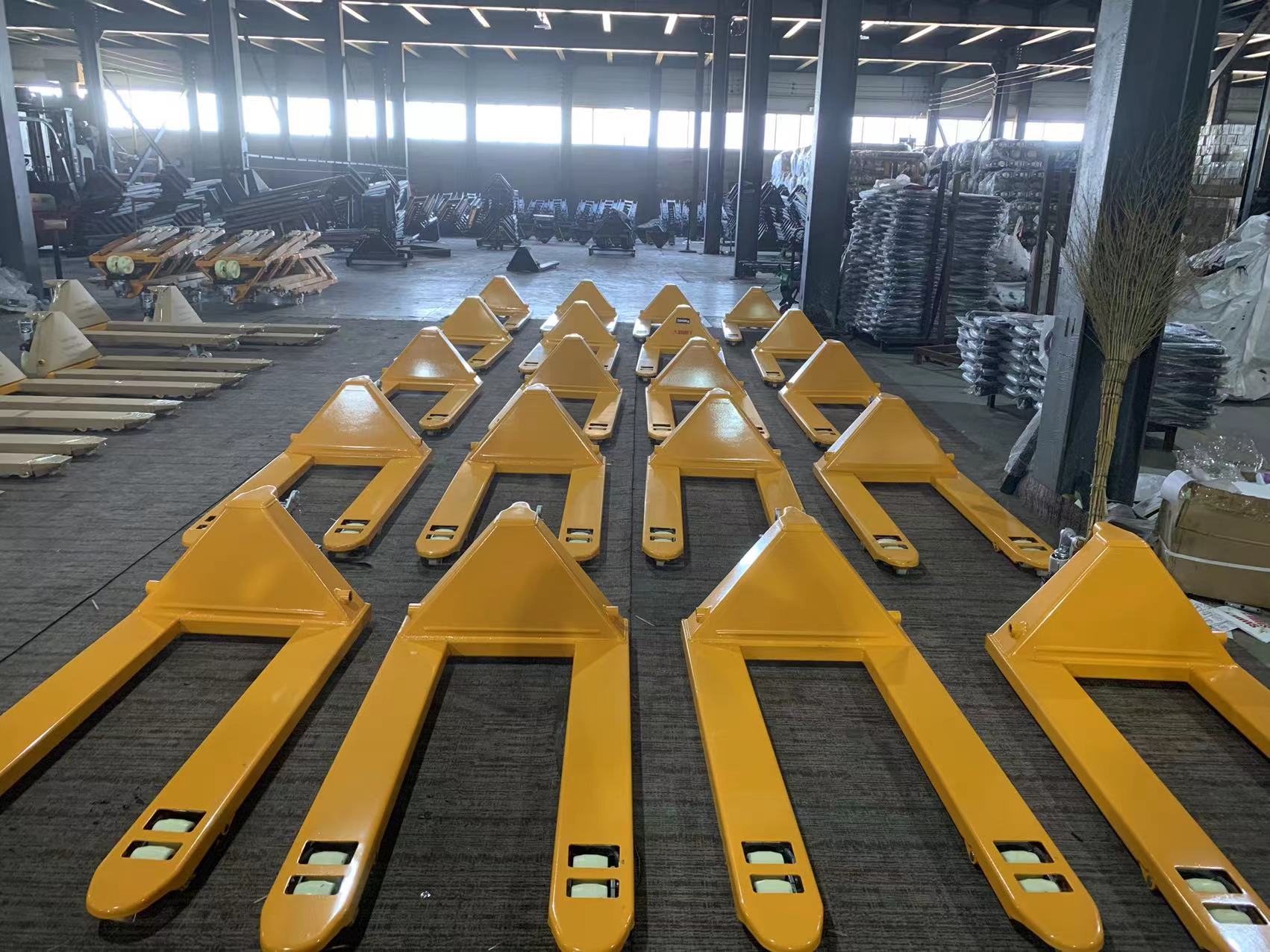
A pallet jack that performs well in a climate-controlled warehouse can fail within months inside a sub-zero freezer room, turn into an ignition risk in a hazardous atmosphere, or produce unacceptable noise in a pharmaceutical cleanroom. Cold storage and explosion-proof areas are two of the most demanding conditions a pallet jack can face, and both require equipment that is specified for the job rather than simply purchased.
This application guide covers what actually changes in cold storage, hazardous (explosion-proof) zones, and quiet-operation environments; how frame materials such as galvanized and stainless steel, wheel compounds, hydraulic configuration, and lifting height are matched to those conditions; and how buyers can verify a supplier's configuration capability before placing an order.
Problem Definition: Where a Standard Pallet Jack Stops Working
A standard hand pallet jack is engineered around three assumptions: an ambient temperature range, a non-hazardous atmosphere, and an operator working at normal noise levels. Cold storage and explosion-proof environments break all three at the same time.
Cold storage and freezer rooms
Sub-zero conditions affect almost every component. Hydraulic oil becomes more viscous, seals lose flexibility, and painted carbon steel frames corrode where condensation collects, typically at weld seams, fork edges, and the pump housing. Rubber and some plastic parts stiffen and can crack under impact. On electric trucks, usable battery runtime drops, and charging inside a freezer room is rarely practical.
Explosion-proof and hazardous zones
Where flammable gas, vapor, or combustible dust is present, the handling equipment itself must not become an ignition source. An electric drive motor, a relay, a battery connector, a static discharge, or a spark from steel-on-steel contact can each be enough to ignite an explosive atmosphere. That changes the question from "which pallet jack is most efficient" to "which pallet jack is permitted in this zone".
Silent operation requirements
Food processing plants, pharmaceutical cleanrooms, and retail backrooms increasingly specify low-noise handling equipment. Rolling noise from hard wheels and pump noise from neglected hydraulics are the two dominant sources, and both are influenced by specification decisions made at the ordering stage rather than by maintenance afterwards.
The practical consequence is straightforward: a pallet jack for these environments needs a different material specification, a different wheel compound, a different hydraulic setup, and, in hazardous areas, a different approach to the drive altogether.
Industry Background: Cold Chain and Hazardous-Area Demand
The global pallet jacks market was valued at approximately USD 7.4 billion in 2024 and is projected to reach USD 11.6 billion by 2034, according to industry forecasts covering 2025–2034. Within that total, manual pallet jacks remained the largest single segment at around USD 4.3 billion in 2024, while the electric pallet jack and stacker segment was valued at approximately USD 5.1 billion in the same year.
Published estimates of the category's total size vary considerably, largely because different reports include or exclude related stackers and conveyors. One 2025 valuation places the market near USD 7.91 billion, while others use a much narrower scope. Buyers comparing market reports should treat headline figures as directional and check what each report actually counts.
Three standards recur when pallet jacks are specified for regulated environments:
- ISO 3691-5:2014 sets safety requirements for pedestrian-propelled trucks, which covers manual and semi-manual pallet jacks.
- EN 1757-2 covers hand pallet trucks in Europe, including trucks with capacities up to 2,000 kg.
- OSHA 29 CFR 1910.178 classifies powered pallet jacks as Class III forklifts in the United States and requires formal operator training.
Cold storage and hazardous-area projects usually layer local requirements on top of these, such as hygiene standards for food-contact surfaces, and zone classification rules for explosive atmospheres. These are project-specific and should be confirmed with the operator's own safety and compliance team rather than assumed from a catalogue.
How Pallet Jacks Are Adapted: Materials, Finishes, Wheels, and Drive
Frame material and finish
Material choice is the most consequential decision for cold storage and corrosive environments.
- Carbon steel with a painted finish is the standard construction and the lowest-cost option. It suits ambient warehouse and factory-floor use, but it is not the right choice where condensation, washdown, or corrosive chemicals are routine.
- Galvanized steel adds a zinc layer that resists corrosion, and it is a common specification for cold storage and humid environments.
- Stainless steel offers the highest corrosion resistance of the three and is the usual choice where hygiene, washdown, and chemical exposure occur together. A stainless surface also does not depend on a coating that can chip or scratch.
Baoding Junyun Hoisting Machinery Co., Ltd., trading as JUNYUNHOIST, is a lifting and material handling equipment manufacturer based in Hebei, China, and lists galvanized and stainless steel pallet trucks among its core products.
Wheels: rolling resistance, noise, and floor protection
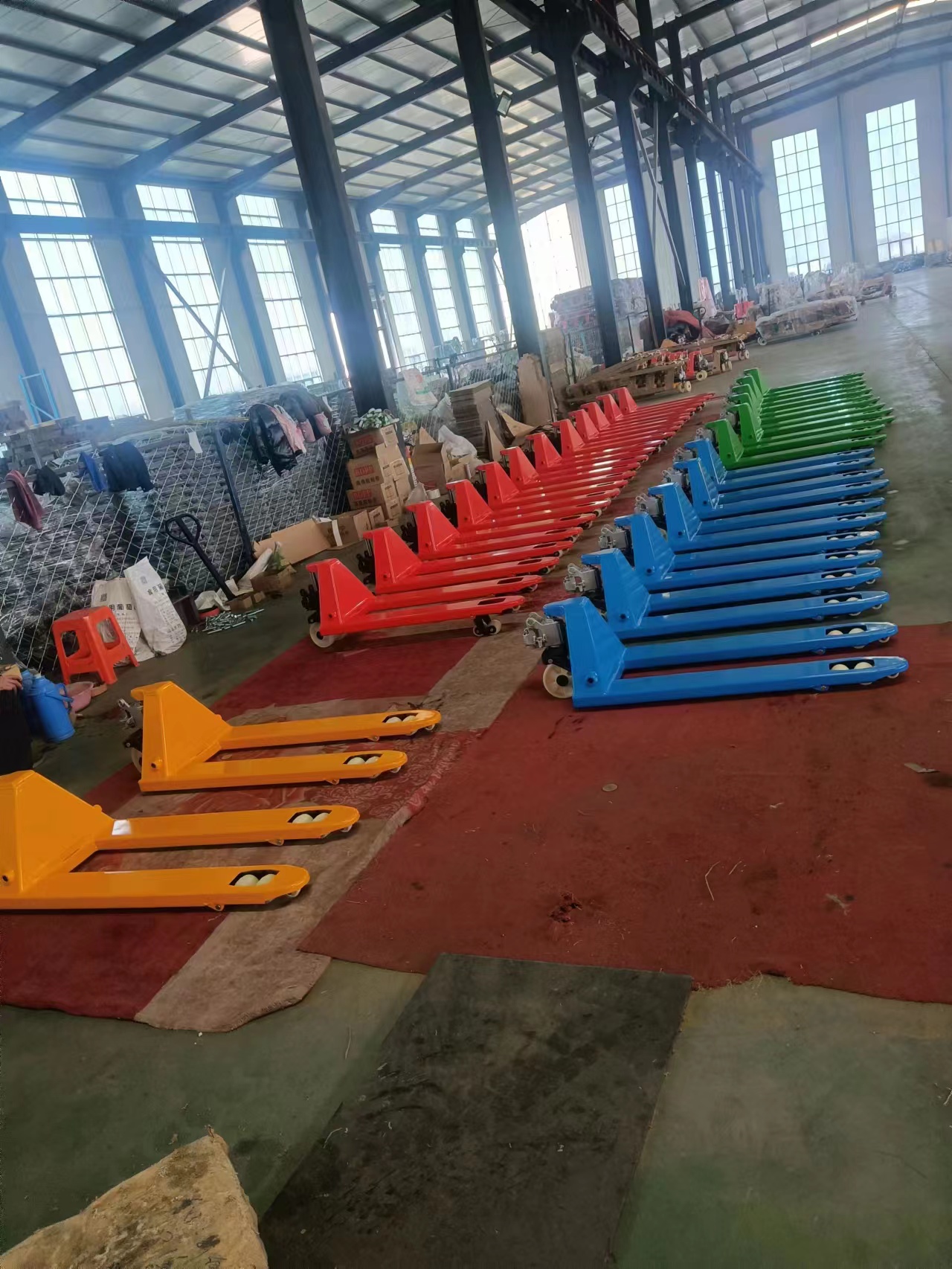
Wheel compound drives both rolling effort and noise level. JUNYUNHOIST's pallet truck platform supports PU, nylon, PP, and rubber wheels:
- Polyurethane (PU) — smooth rolling, relatively quiet, and gentle on floors; widely used in warehouse, food, and cold-room applications.
- Nylon — very low rolling resistance and high load capacity, but harder and louder than PU.
- PP (polypropylene) — resistant to water and to many chemicals.
- Rubber — high grip and low noise, chosen where traction and floor protection matter more than rolling effort.
Forks and lifting height
Fork geometry determines whether a truck can enter a given pallet and whether it fits under low-clearance racking or conveyor feed points. Available fork widths on the JUNYUNHOIST pallet truck platform include 550 mm and 685 mm, with fork lengths of 1150 mm, 1220 mm, 800 mm, 1500 mm, 1800 mm, and 2000 mm. Standard minimum height is 80 mm and maximum height is 200 mm, and lower minimum lifting heights of 35 mm and 62 mm are available through customization.
Hydraulics in low-temperature operation
Hydraulic performance is where cold storage first shows up as an operational problem. As temperature falls, hydraulic oil becomes more viscous and seals stiffen, which slows lift and can make the pump feel unresponsive. Buyers specifying for a freezer room should confirm that the hydraulic oil grade covers the lowest operating temperature on site, and should treat condensation management, meaning drying and lubricating moving parts after cold-to-warm transitions, as part of routine maintenance rather than an optional extra.
Manual versus electric in cold and hazardous areas
A manual pallet jack has no motor, no battery, and no electrical drive. In many hazardous zones this makes it the preferred option, because the ignition sources associated with powered equipment are absent by design. Any add-on electronics, including a weighing scale, must still be assessed separately against the zone classification.
Electric pallet trucks remove operator effort and are the logical choice for high-throughput cold storage, but two constraints apply: battery capacity falls in low temperatures, and every electrical component must meet the zone's classification requirements where a hazardous atmosphere is present.
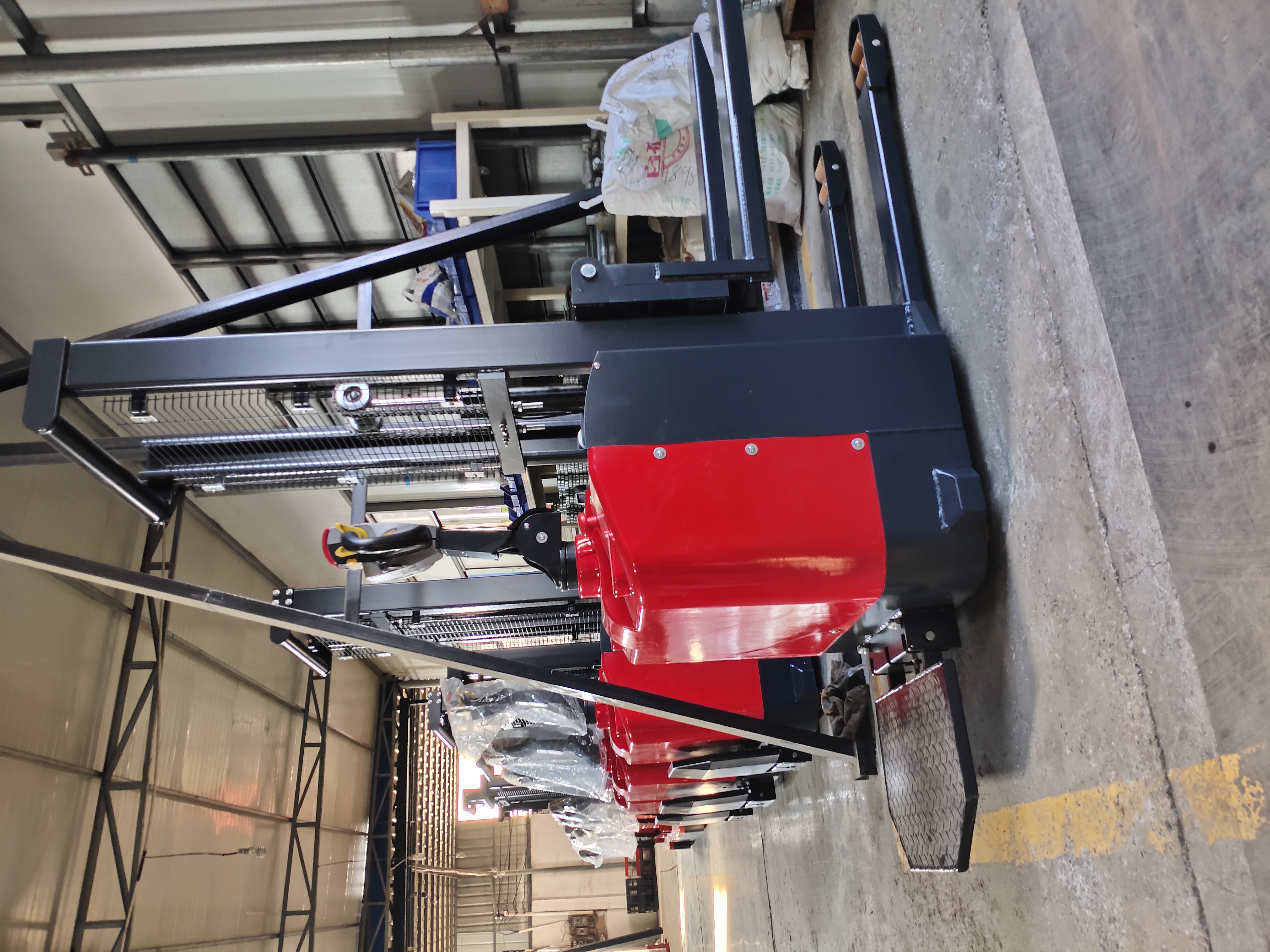
JUNYUNHOIST produces semi-electric pallet trucks, full electric pallet trucks, pallet truck with scale, and galvanized and stainless steel pallet trucks on the same platform.
Weighing and in-process configurations
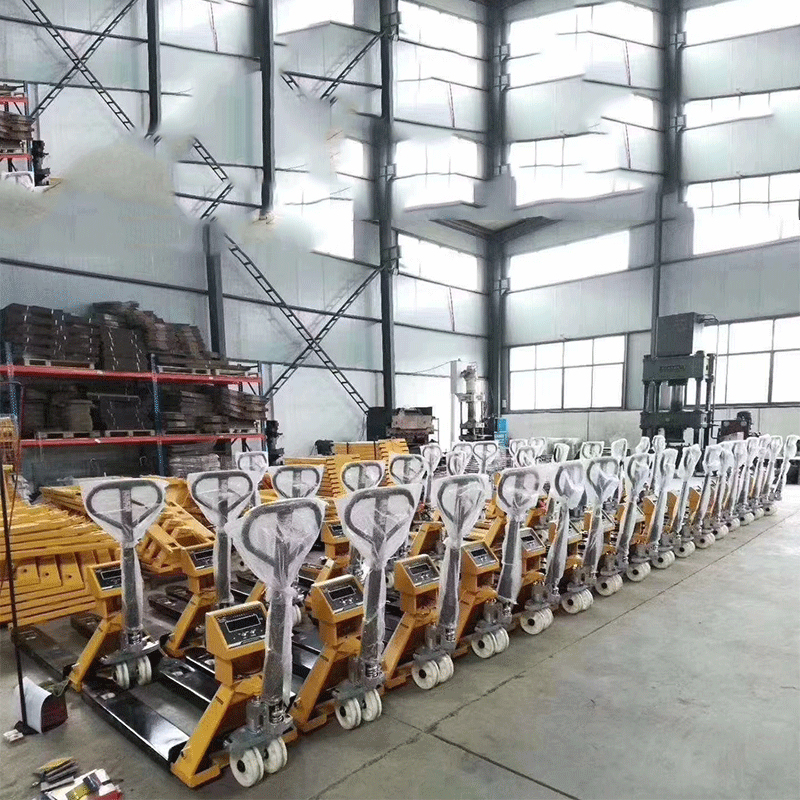
A pallet truck with an integrated scale captures load weight during handling instead of at a separate weighing station. That matters in food and chemical operations where batch records are required, and it removes the double-handling that a separate scale creates. As noted above, weighing electronics used in a hazardous area need their own assessment before deployment.
Customization Options That Match Special Environments
JUNYUNHOIST provides both OEM and ODM production services. Documented customization options for its pallet truck line include:
- Fork length and fork width
- Minimum lifting height options including 35 mm and 62 mm
- Fork steel plate thickness
- Electric pallet truck configuration
- Galvanized and stainless steel pallet truck builds
- Pallet truck with scale
These options are what allow one pallet truck platform to be configured for ambient warehouse use, a cold storage room, a food processing plant, or a chemically aggressive environment, instead of forcing the buyer to choose between a standard truck that corrodes and a fully bespoke unit that is difficult to source and support.
Step-by-Step: Specifying a Pallet Jack for a Special Environment
Step 1 — Define the environment envelope
Temperature range, humidity and condensation, washdown chemicals, dust or gas classification, and any noise limits. Every later decision depends on this step.
Step 2 — Map the load and the pallet interface
Pallet type, load weight, and entry side. Confirm fork width, fork length, and the minimum height needed for low-clearance racking or conveyor feed. Minimum height options of 35 mm and 62 mm exist for tight-clearance cases.
Step 3 — Select material and finish
Carbon steel for ambient dry storage, galvanized steel for cold and humid rooms, stainless steel for hygiene and chemical exposure.
Step 4 — Select wheel compound and drive type
PU or rubber where noise matters, nylon where rolling effort matters, PP where chemical resistance matters. Manual drive for hazardous zones and lower-frequency handling; electric drive for high-throughput cold storage.
Step 5 — Fix the hydraulic and sealing specification
Confirm that the oil grade and sealing material are rated for the lowest operating temperature, and agree a condensation-maintenance routine with the operator.
Step 6 — Verify compliance and testing
Ask for the applicable standard, the zone or hygiene documentation, and the quality-control process. JUNYUNHOIST implements 100% testing for quality control on its pallet truck production.
Step 7 — Confirm commercial terms
Typical production lead time is 15–20 days and the minimum order quantity is 24 pieces. Delivery terms available include FOB, EXW, CIF, and CFR. Acceptance can be handled through a pre-shipment test and third-party inspection such as SGS, and standard payment terms are 30% T/T in advance with 70% T/T against a copy of the B/L.
Use Cases in Food, Chemical, and Pharmaceutical Operations
Cold storage and freezer warehouses
Galvanized or stainless steel frame, cold-rated hydraulic oil, and PU or nylon wheels sized so the truck rolls easily on a wet concrete floor. Electric drive becomes worthwhile once pallet movements are frequent enough that manual effort limits throughput.
Food processing plants
Stainless steel and food-grade material specifications dominate, because washdown, hygiene, and corrosion resistance all point the same way. Lower minimum lifting heights of 35 mm and 62 mm help where pallet entry is tight or where product moves on low-clearance conveyor feed.
Chemical plants and hazardous zones
The first question is not which pallet jack, but which equipment is permitted in this zone. Manual pallet jacks, with no motor, battery, or electrical drive, are frequently the practical answer, supported by attention to wheel material and any weighing electronics.
Pharmaceutical and cleanroom operations
Stainless steel surfaces, smooth wheels, and low-noise rolling support a cleanroom-compatible handling routine, and a pallet truck with an integrated scale can capture weight data during handling rather than in a separate step.
Supermarket backrooms and distribution centers
These facilities mix ambient and chilled rooms inside one building, which makes a mixed fleet with consistent parts and service support more practical than a single truck type.
Comparison Table: Matching Configuration to Environment
| Environment | Frame and finish | Wheel compound | Drive type | Why it fits |
|---|---|---|---|---|
| Ambient warehouse / factory floor | Carbon steel, painted | PU or nylon | Manual or electric | Lowest cost; dry, non-corrosive conditions |
| Cold storage / freezer room | Galvanized steel | PU | Manual or electric | Zinc layer resists condensation corrosion; PU rolls well on wet floors |
| Food processing / washdown | Stainless steel, food-grade materials | PU | Manual or electric | Hygiene and corrosion resistance; smooth, cleanable surface |
| Chemical / corrosive exposure | Stainless steel or galvanized steel | PP or PU | Manual | Chemical resistance where splash or vapor is present |
| Explosion-proof / hazardous zone | Confirmed against the zone classification with the supplier | Non-sparking and anti-static options to be confirmed per project | Manual preferred; electric only where classified | Removes electrical ignition sources from the drive |
| Quiet areas (pharma, retail) | Approved finish for the hygiene level | PU or rubber | Manual or electric | Lower rolling noise than hard nylon or steel wheels |
Hazardous-area configurations depend on the zone classification of the specific site. The table shows the direction of the specification, not a substitute for the site's own compliance assessment.
Manufacturer Capability Snapshot
| Item | Detail |
|---|---|
| Production services | OEM and ODM |
| Customization | Fork length and width; minimum lifting height 35 mm / 62 mm; fork steel plate thickness; electric pallet truck; galvanized and stainless steel pallet truck; pallet truck with scale |
| Quality control | 100% testing |
| Monthly production capacity | 10,000 units |
| Typical lead time | 15–20 days |
| Minimum order quantity | 24 pcs |
| Delivery terms | FOB, EXW, CIF, CFR |
| Acceptance | Pre-shipment test; third-party inspection (SGS) |
| Payment terms | 30% T/T in advance; 70% T/T against copy of B/L |
| After-sales | Free spare parts for wear-and-tear items with each container, replenished as needed based on subsequent wear |
| Main export markets | India, Türkiye, Brazil, Vietnam, Russia, UAE, the Middle East, and Southeast Asia |
A documented deployment illustrates the pattern. An importer project used 400 units over a two-year period for distribution into local stores across India, Brazil, Russia, Belarus, Turkey, the UAE, and Vietnam. The reported results were high quality, low loss, and high efficiency, with users describing the equipment as convenient, practical, simple, efficient, and labor-saving.
Frequently Asked Questions
Q1. What should buyers verify for compliance before ordering a pallet jack for cold storage or a hazardous area?
Start with the standard that applies to your market. ISO 3691-5:2014 covers safety requirements for pedestrian-propelled trucks, which includes manual and semi-manual pallet jacks; EN 1757-2 covers hand pallet trucks in Europe for capacities up to 2,000 kg; and powered pallet jacks fall under OSHA 29 CFR 1910.178 in the United States, which treats them as Class III forklifts and requires formal operator training. Cold storage projects usually add hygiene and washdown requirements on top of these, and hazardous-area projects add zone classification rules. Ask the supplier for the documentation that applies to your specific configuration, and confirm the quality-control process — JUNYUNHOIST implements 100% testing for quality control on its pallet truck production.
Q2. Can a pallet jack be customized for cold storage, corrosive, or other special environments?
Yes, within the manufacturer's documented customization range. JUNYUNHOIST provides OEM and ODM production services with customization for fork length and fork width, minimum lifting height options including 35 mm and 62 mm, and fork steel plate thickness. The same platform also supports electric pallet truck configuration, galvanized and stainless steel pallet truck builds, and pallet truck with scale. For cold storage, galvanized or stainless steel construction is the usual starting point; for washdown and hygiene areas, stainless steel is the more appropriate choice.
Q3. What are the minimum order quantity and the commercial terms?
The minimum order quantity is 24 pieces, and the typical production lead time is 15–20 days. Delivery terms include FOB, EXW, CIF, and CFR. Standard payment terms are 30% T/T in advance with 70% T/T against a copy of the B/L. Because material choice — carbon steel versus galvanized versus stainless steel — is the largest single cost driver in this category, it is worth fixing the environment specification first and costing the configuration afterwards, rather than comparing prices on trucks built to different material standards.
Q4. Can the configuration be validated before shipment?
Yes. Acceptance criteria can include a pre-shipment test and third-party inspection such as SGS. Cold storage and hazardous-area performance depends on details that are hard to judge from a catalogue, including hydraulic behaviour at low temperature, wheel compound, and finish quality, so validation before shipment is the practical way to confirm the specification actually matches the environment.
Q5. What is the production capacity and lead time for repeat orders?
Monthly production capacity is 10,000 units, with a typical lead time of 15–20 days. Each container is supplied with free spare parts for wear-and-tear items, replenished as needed based on subsequent wear, which matters in cold storage and washdown environments where wheels, seals, and hydraulic components wear faster than in ambient warehouses. If your project needs a specific configuration or a repeat supply schedule, send your environment specification and target volumes to JUNYUNHOIST to request a quote or a sample.
Conclusion: Specify for the Environment, Not the Aisle
The difference between a pallet jack that lasts and one that fails in a freezer room or a hazardous zone comes down to specification decisions made before the order, not maintenance after it. Frame material and finish, wheel compound, hydraulic oil grade, drive type, and lifting height each need to be matched to the environment the truck will actually work in.
For cold storage, galvanized or stainless steel construction with cold-rated hydraulics and PU wheels is the typical baseline. For hazardous zones, a manual truck with no electrical drive is often the practical answer, and any weighing electronics must be assessed against the zone classification. For food, chemical, and pharmaceutical operations, stainless steel and food-grade materials carry the hygiene and corrosion requirement.
JUNYUNHOIST supplies manual, semi-electric, and full electric pallet trucks, galvanized and stainless steel pallet trucks, and pallet trucks with scale, backed by OEM and ODM customization, 100% quality-control testing, a monthly capacity of 10,000 units, and a typical lead time of 15–20 days.
Next Step
Send your environment specification — temperature range, zone classification, pallet type, and target volume — and JUNYUNHOIST will confirm the matching configuration, finish, and wheel compound for your project.
Request a sample or a quote, or download the full product brochure: JUNYUNHOIST Product Brochure (PDF).
Website: www.junyunhoist.com | Email: Junyunsteven@163.com | Tel / WhatsApp: +86 134-8345-2631
Have Questions or Need More Details?
Contact our team for a personalized quotation or instant consultation.
Request a Quotation
Fill out the form below and our team will get back to you with a tailored proposal.
WhatsApp Direct Chat
Prefer to chat in real-time? Message us on WhatsApp for instant assistance & quick answers.
- Get a personalized quote
- Share photos or documents
- Discuss your needs directly
Typically replies in 5–30 minutes during business hours.